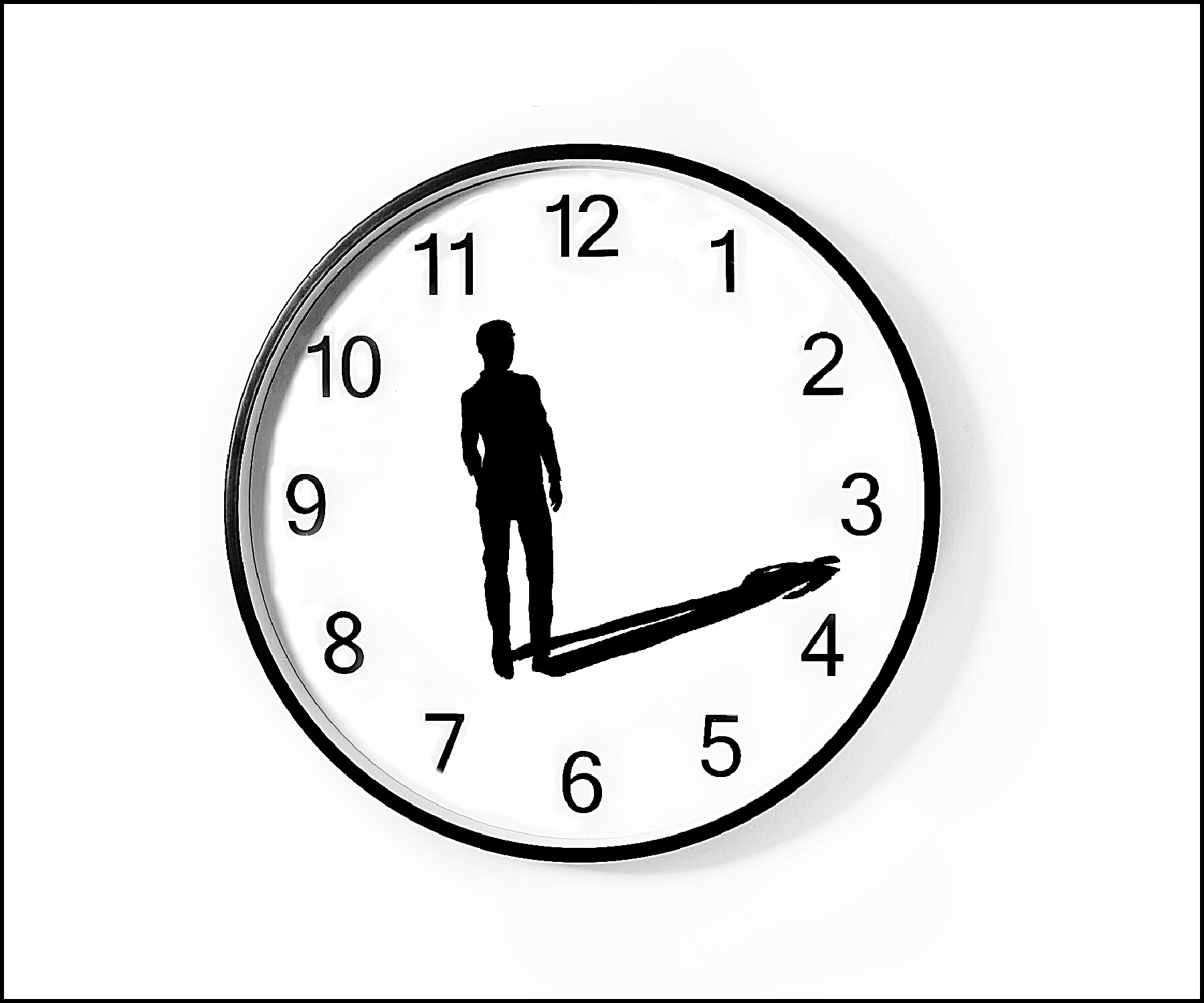
man-in-clock

Time Is What A Clock Shows

Time Is What A Clock Shows

  When you want to know the time, you can look at a clock or your smartphone. 

I think Einstein said, "Time is what clocks measure," but he didn't know about computers or smartphones.

(copyright: lovinthings.com/)

Most science websites mention that Einstein said, "Space is what we measure with a ruler; Time is what we measure with a clock."

It's difficult to say who said what because Einstein passed away in 1955. Maybe he said, "Time is what a clock shows," or "Time is what clocks measure," or both quotes?

These two sayings have different meanings. Clocks don't measure anything. Clocks show you the present time or moment. 

You measure your daily events with the time that a clock shows. Yes, time is what a clock shows. But what is time?

We must define the meaning of time before we talk about time. Time is difficult to define because Einstein said time is relative. 

It's true time changes if gravity changes. But let's put that aside for now and focus on the time right now. 

Your Perception of Time

Everyone has their perception of time because it's very personal. You have a daily routine, and you prioritize your time for your daily events. 

People perceive time in different ways, so time is a subjective experience that governs your daily activity. 

Science invented timekeeping for you to keep track of your life with clocks and calendars. 

Time isn’t a physical thing that can cause motion or a change to something. It sounds weird, but time is a measurement of motion and then called time. Let me explain.

Every physical thing is moving at light speed. 

Your body is made of atoms and electrons in constant motion and gives off photons of heat and energy. 

This motion exists in the universe and started with the Big Bang event. 

Our invention of time measures motion and motion is real, but time isn’t real. Time is a measurement of motion, and we use the earth's motion to keep track of our life.

Think of it this way

We feel gravity and time. We have measured the force attracting us to the earth and called it gravity. We have measured the motion of the Earth and called it time.

In physics, we use time to describe motion and energy accurately. The only way to describe the motion in the universe is to use the motion on a clock. 

However, the clock's motion is an invention to describe the motion of Earth. The main thing to understand is that motion is real, and time is a measurement of motion.

Timekeeping

The ancient keepers of time recorded events on clay tablets. Timekeeping is the modern way to keep track of time.

The universe is full of motion, and we use clocks to measure motion.

Timekeeping uses clocks, calendars, and computers to document history. 

You use timekeeping to keep track of your events and timeline.

Time itself doesn't exist except what the clock shows you. We call the display on a clock the time, and we use the word time to mean all kinds of things. 

Your times include sleep time, exercise time, parking time, movie time, playtime, school time, lunchtime, vacation time, and countless other things.

Modern society needs timekeeping tools to keep track of the day's events, the history of the past, and future appointments. 

However, everything happens in the present moment. What is a moment?

A clock ticks 86,400 times each day, and we use those ticks as seconds to compare how fast other things move. 

Everything we measure is compared to the motion of Earth. 

Your heart beats 72 times per minute, compared to the duration of one minute of the Earth's motion. 

You drive your car at 100 km/hr, compared to the rotation of Earth in one hour. Each second, the Earth moves 1/86,400th of a rotation. 

The Error in a Clock's Time

My question is, if light moves at 3 x 10^8 m/sec, compared to the rotation of Earth in one second, how fast does light move in space? 

Scientists have measured the speed of light using the Earth-second, but the Earth-second occurs faster in space. Time is relative to the force of gravity. 

The speed of light in the vacuum of space is measured with clocks sitting in Earth's gravity. But Earth time has gravitational time dilation built into the second. 

A clock's time moves 45 microseconds per day faster in space. How much of an error is that in 13 billion years?

Time is an abstract thing that doesn’t exist outside of now. Time is a measurement using a clock that displays numbers. 

You don’t live in time or move in time. You live and move on a moving planet.

You count your age by the number of years you have lived, but the years represent the number of trips you made around the sun. 

Time doesn't exist. The motion of your heart, planets, and electrons exist. 

The Motion of Time 

Electrons orbit atoms at light speed and emit photons that move at the speed of light. The motion of electrons and light started when the universe was born. 

The Motion of electrons moves, light moves, and the Earth moves. Time has nothing to do with motion. 

Clocks measure motion, but more than that, humans have invented time from the motion of our planet. 

Time exists as a measurement of motion. A clock’s time follows the rotation speed of our planet. 

A clock in a stronger field of gravity will slow down, and in a weaker gravity a clock speeds up. 

Time is the display on a clock, and clocks are affected by gravity. Time doesn’t slow down or speed up. Clocks slow down and speed up depending on the force of gravity. 

Time exists as a number on the clock that corresponds to the motion of Earth. Timekeeping is how we use the time to keep track of the events in our life. 

It's confusing because you see the time on a clock move and timekeeping move, but it's the motion that moves. Time is the measurement of motion. 

The Definition of Time

Time is what the clock shows. 

The display of time on a clock moves at the same rate as the Earth. 

Scientists use time to measure the motion of other things compared to the motion of Earth.

But time has no physical qualities that can cause an action or event because time is only a measurement.

A clock and the time on a clock are the two things that work together. A clock ticks 86,400 seconds per day, and the Earth rotates every 86,400 seconds. 

A clock is a real thing, but it displays numbers that correspond to your position on Earth.

Numbers are not real things. They are the measurements of Earth's rotation. We call the numbers "time." but time isn't real. 

Time is a system of keeping track of events by using the invention of timekeeping. 

Knowing the meaning of time does not change anything for most people. But if you are a scientist, you must consider time dilation and the error of time.

If you enjoy reading my articles, join my blog at https://lovinthings.com/ 

Thanks for being here, take care, and be safe.

About the Author Erik Lovin

Erik has a BSc degree and is a retired professional photographer who is now a published author of many books. His passion is understanding how life and the universe work. He is currently blogging about the science of the Big Bang and science in your life. Erik is helping his tribe with questions about the universe. His goal is to help find a theory of everything (TOE). In order to do that, he is trying to prove light has mass and that the fabric of spacetime is a false theory. We are welcoming questions and answers that you might have about the universe.

follow me on: