Blog

  • Einstein’s Errors In Relativity

    Einstein’s Errors In Relativity

     Einstein’s Errors in Relativity

    This article isn’t about fixing Einstein’s errors but knowing why they need fixing. Your first step in understanding something isn’t how something works but why it exists in the first place.

    If you know its purpose, you can search for reasons and errors. 

    We are all familiar with the child who wants to know the answer to everything. When you answer, they keep asking you, but why, again, and again. 

    If you can’t explain something to a 5-year-old, maybe you don’t understand it?

    I apologize to Einstein because it’s always easier to criticize someone else.

    How Does Einstein’s Relativity Work

    A man who needs a new tool, but hasn’t yet acquired it, is already paying for it.  

    When you don’t understand why things work the way they do, you can’t see an error in how it works.

    Einstein’s Special Relativity says that an object cannot move at the speed of light. 

    It’s true; matter with rest mass can’t move at the speed of light. 

    When a thing travels at the speed of light, a thing gets smaller (length contraction), becomes infinitely massive, slows time down to a stop (time dilation), and needs infinite energy to move. 

    These things are impossible, right?

    We can’t compare light to other particles because of the relativistic nature of light. 

    Einstein said light is massless, and that’s why it can travel at light speed. 

    But light has mass as relativistic energy, and light doesn’t accelerate to light speed. It’s created at light speed. 

    Einstein’s math suggests that a moving object gains mass, gets smaller, and its time slows down. 

    What happens is that a force of energy must exist to accelerate an object. 

    The acceleration force is gravity, and the object’s mass will increase as more energy is used. 

    The increasing mass will slow down the frequency of matter in quarks. 

    The slower frequency of quarks (Quantum Chromodynamics) slows down time only because time is a measurement of the frequency (oscillations) of the cesium-133 atom.

    Most physicists don’t know what length contraction is. 

    If anyone tells you that objects get shorter in a particular reference frame, they don’t understand time dilation. 

    When they measure the length of things, they don’t use rulers or tape measures in relativity; they use clocks. 

    Apparent length contraction happens at relativistic speeds when a clock’s time slows down.

    If an object moves from point A to point B faster, the distance doesn’t decrease. 

    The object is just moving faster between A and B. 

    But during relativistic speeds, the clock slows down and shows that much less time happens to move from A to B. 

    Length contraction of space is a result of a clock’s time dilation, but physically the length doesn’t shrink. 

    It’s a false mathematical calculation because of gravitational time dilation.

    The Error of Definition

    Einstein made an error when he didn’t define time. 

    Working only with mathematics leads your imagination to believe that numbers are real things. 

    They are not, and they can lead to false answers. 

    The Error of Time on Earth

    Einstein said time is relative. But he didn’t know that the time on Earth’s clocks has an error of time dilation. 

    The truth is that time is relative to gravity. Time is what a clock shows.

    Gravity affects all physical things, and the force of gravity on Earth adds time dilation to our clocks.

    Gravitational time dilation has been proved on Earth and in the GPS clocks in space. 

    But scientists haven’t transferred the error into their equations. 

    The speed of light has an error because clocks move faster in space by at least 45 microseconds per day. 

    And we measure the speed of light with clocks that are 45 microseconds per day slower. What’s the error during one light-year? 

    Spacetime is a geometric description of the force of gravity. 

    Light has energy and relativistic mass, so it bends towards a source of gravity just like any other mass. 

    To give accurate results in Einstein’s field equations, you must consider the error of time. 

    The Error of Observation

    Many mind experiments and examples of relativity use the idea of comparing a clock from one frame of reference with a clock in another frame of reference. 

    You can’t compare clocks that are millions of miles away from each other. 

    It’s full of error and an impossible situation.

    The Error of Gravity

    Einstein said gravity is described by the geodesic paths that objects follow when approaching a large mass, such as the Sun. 

    But a description of gravity isn’t gravity. He had no idea where the force of gravity comes from. 

    Now his description of gravity has become a theory of gravity. 

    Gravity is one of the fundamental forces in nature, and it comes directly from the mass. 

    The only thing inside matter that could create gravity is the quark-gluon interaction inside atoms that gives mass to fundamental particles. 

    My book, Einstein: Distorted By Gravity–A New Theory of Gravity, explains how quantum chromodynamics is the cause of gravity.

    Errors of Black Holes 

    Black holes are too far away to be seen, so there’s an observation error. 

    The idea of spaghettification and Hawking radiation is just a theory. Stephen Hawking suggested spaghettification if a person falls into a black hole. 

    Several stories about black holes explain what you would see inside a black hole. 

    The infamous stopping of time by time dilation is what someone would see when looking at a spaceship entering a black hole. 

    All of these are stories that border on science fiction. I would like to leave science fiction out of science, even if they sell many magazines or books. 

    Einstein’s Twin Paradox

    Einstein’s mind experiment takes place when one twin goes into a spaceship and travels at almost the speed of light and, upon arriving back, sees that his twin is much older. 

    The idea behind this scenario is that a clock slows down during the force of acceleration (gravity). 

    Therefore, they assume that time slows down for the spaceship twin. 

    But a clock and the time on a clock are two different things. 

    Clocks are physical things affected by gravity, and so are we. 

    If gravity slows down a clock’s ticking rate, a beating heart will also slow down. Before the clock’s time stops, the twin’s heart would stop. 

    A spaceship has too much mass to travel fast enough for time dilation to make any difference. 

    But, the effects of stress and gravity on the spaceship twin would make him older if he remains alive. 

    The Error of Observing Motion

    When two spaceships are together, and one moves away from the other ship, they say that it’s impossible to tell which one is moving relative to the other spaceship. 

    The math involved states that each spaceship sees the other one moving away. 

    That’s true if you only rely on math or observation. 

    But the spaceship that feels the effects of acceleration from its engine is moving away from the other one. 

    If they go in opposite directions simultaneously, they can’t tell by observation alone if the other ship is also moving. 

    The Error of Time Travel

    I think Einstein said that time travel to the past is theoretically possible. 

    He claimed that the math equations might work backward in general relativity spacetime geometries such as cosmic strings and wormholes. 

    Math can work backward, but there is a direction of motion. 

    The entropy of a closed system such as the universe always increases in the forward direction of motion. 

    You can’t unscramble an egg, make the Earth spin backward, or move light backward.

    Using time dilation to time travel to the future is a widespread belief. 

    Stephen Hawking said time travel to the past is impossible but possible in the forward direction of time. 

    Einstein’s Twin Paradox is the same idea. The mistake they make is thinking that time has physical powers. Time is a number on a clock. 

    The clock is a physical thing, but time is a number. Gravity affects physical things such as clocks, but time isn’t a thing. 

    The time dilation on a clock doesn’t change anything. Time is a number on a clock, and we are always in the present moment. 

    If you travel at light speed and come back to Earth, you took a trip and returned to the present moment.

    Stephen Hawking made many weird statements to sell more books. 

    He even hosted a party for time travelers as a joke, some people thought he was serious, but no one showed up. 

    I claim that time travel cannot exist because time isn’t a physical thing, motion only moves forward, and the biological effects of gravity would be the death of an astronaut. 

    The Photon Clock Experiment

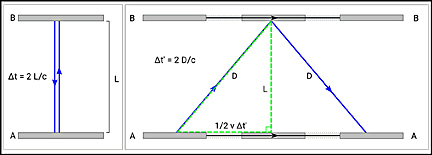
    This thought experiment uses two perfect reflecting mirrors with a photon bouncing between them.  I claim that using a bouncing photon cannot show time dilation. 

    There are several errors in this mind experiment. 

    1. The speed of light is invariant, so it can’t take longer to move between a fixed distance.

    2. The mirror absorbs the photon, and an electron releases a new photon.

    3. They assume that the mirrors are perfect reflectors.

    4. Photons are invisible, but the experiment describes the path as visible.

    5. A photon clock needs a counter which is a physical device, and the counter will experience gravity and show an error of time dilation.

    6. The Lorentz transformation isn’t valid since the photon is invariant and has no mass.

    7. A Photon Clock and relativistic speeds of trains and spaceships don’t exist.

    If they replace the photon with a bouncing ball, then the Lorentz transformation would show that gravitational time dilation happens due to the longer path that the ball takes.

    Time is what a clock shows relative to a force of gravity, temperature, pressure, and humidity. 

    If you don’t understand why clocks show you the time, your time will cost you production and wisdom. 

    The error on a clock’s display is called time dilation, and the reason why a clock’s time changes is that gravity affects all physical things.

    The law of entropy is like a law of motion. The motion we see and measure with clocks always moves forward. 

    The Earth can’t reverse direction any more than light can travel backward. We can look back and learn why things work, but we can’t move backward. 

     A good rule to follow is this, “Life can only be understood backward, but it must be lived forwards.” — Søren Kierkegaard.

    The takeaway, from this article, is to show how many errors exist in the explanation of things we don’t fully understand. So please be lenient on my mistakes. 

    Thanks for your time here at https:/lovinthings.com/

    As always, take care, and be safe.

  • The Ultimate Definition of Time

    The Ultimate Definition of Time

    The Ultimate Definition of Time 

    Motion is measured with a clock. Therefore, time is the measurement of motion. Time and motion move together, and time is what a clock shows. 

    The planets orbit the Sun, our star. The motion of each planet is different, and we can measure how fast they move relative to our motion on Earth. 

    Where there is motion, there is time because time is how we measure motion. 

    When you drive your vehicle at 100 km/hr, the motor supplies the power, and you regulate it with your foot on the accelerator pedal. 

    The speedometer shows you how fast you are moving. You can travel 100 kilometers in one hour on planet Earth at that speed. 

    Time And Tide Wait For No One

    Time is the measurement of motion, but the motion of things doesn’t depend on time. 

    Time isn’t something that waits or moves. The Earth moves, and tides move. 

    Time is the measurement of the motion of Earth and its tides. Time happens because motion happens, but time is just the measurement of how fast motion happens. 

    But not just any motion. 

    The universe is full of motion, and the motion of our planet is what we call time. 

    In the beginning, time was the length of one day. With the invention of clocks, the time of one day was made into 24 hours, each hour into 60 minutes, and each minute into 60 seconds. 

    At first, the hour was divided into 60 minutes, and after the second division of a minute, it was called a second. The second became the smallest unit of time, so a day has 86,400 seconds. Strange but true.

    The second is one unit of time or 1/86,400th of a day. 

    Science has measured the duration of one second by using the oscillations of a cesium-133 atom. 

    The second is defined as being equal to the time duration of 9,192,631,770 periods of the radiation corresponding to the transition between the two hyperfine levels of the fundamental unperturbed ground-state of the cesium-133 atom. That’s a mouth full, eh?

    The confusion we have is that a clock’s ticking moves, and timekeeping moves, so we think that time moves; instead, it’s the Earth that moves. 

    A clock is an invention that ticks at the same rate as the Earth moves, and the display on the clock is called time. 

    The Speed of Motion

    If we don’t differentiate between time and the time (display) on a clock, we will have errors in the mathematics of science. 

    Time in scientific events and durations must be accurate to give reliable results. What is the definition of a clock and time? 

    Time is an abstract thing that doesn’t exist outside of now. 

    Time is a measurement using a clock that works using numbers. 

    You don’t live in time or move in time. Time and time dilation are misunderstood concepts. 

    Time is a man-made motion measuring system based on the motion of earth using units of seconds. 

    Most people make the error of thinking that time is the same as motion. Let me explain. 

    Time is what a clock shows, and motion is the moving second hand on a clock. The second hand of a clock moves at the same rate as the Earth. 

    Time is what a clock shows when you look at the display. 

    The Motion of Atoms and Time

    The unit of time is the second, and the measurement of its length is measured more and more accurately. 

    The way I see it, they measure a second with a better second. 

    Namely, that time is measured with time, or more accurately, motion is measured by counting motion and calling it time.

    Time isn’t real because it’s defined by the motion of an atom. The motion is real, and time is the measurement of the motion. 

    A clock is said to measure time because Einstein said, “Time is what a clock measures.” But he was wrong; my reply is, “Time is what a clock shows.”

    Timekeeping tools became accurate with pendulum clocks, then quartz clocks, followed by the cesium clock, and now a quantum clock. 

    Every clock measures motion, not time, and then displays it as time. Time is what a clock shows. 

    Time doesn’t go backward or stop. A clock keeps on ticking unless it runs out of power or gravity stops it. 

    Clocks use Motion to Measure the Length of a Second

    Since 1968, the International System of Units (SI) has defined the second as the duration of 9,192,631,770 cycles of the cesium-133 atom. 

    They say that it will keep time to within one second over 100 million years. But some newer atomic clocks can do much better.

    The quantum strontium clock, from the National Institute of Standards and Technology and the University of Colorado Boulder, measures the movement of strontium atoms. 

    All atoms have a consistent vibrational frequency (for strontium, it’s about 430 trillion times per second).

    The measurement of these movements is used to create the clock’s “tick.” 

    This clock is accurate to one second in 15 billion years.  Such a clock can measure a change in its elevation of as little as 2 cm due to gravitational time dilation.

    You might wonder why a clock needs to be so accurate to motion? 

    There are two important facts about matter. Atoms vibrate or have a frequency, and time is relative to gravity. These two things are necessary for the proof of my theories. 

    The energy in atoms vibrates, and the measurement of that motion is what we call time.

    Energy in the quantum vibrations of atoms (QCD) converts motion into quantum gravity. 

    Thus, a force of gravity can change the vibrations of matter and change time because time is a measurement of the vibrations (motion).

    Can Motion Move Faster than the Speed of Light?

    The speed of light is the fastest in the universe. Is it possible for any motion to move faster than light? 

    Photons are the quanta of light, and they come out of electrons at the speed of light.

    When scientists look inside atoms, they see an amazing movement of energy. The electrons must be moving at the speed of light since they release photons at light speed. 

    Normally, only photons can move at the speed of light, but quarks and gluons inside atoms are also moving at light speed.

    When an object moves, you can calculate that the electrons are moving faster than the speed of light relative to a stationary object.

    Another way to look at motion is to consider that electrons are moving at light speed. 

    If an object moves at 99% of light speed away from another object moving at 99% light speed, then the speed of electrons relative to a frame of reference moves almost twice the speed of light. 

    In the same way, if two galaxies are moving away from each other, they are speeding away faster than the speed of light. 

    Thus motion can move faster than light in certain frames of reference. 

    Are you thinking about time now, lol? Thank you for following my blog and website at https://lovinthings.com/.

    As always, be well, and stay safe.

    Erik at eriklovin@gmail.com

    Join our Newsletter