Blog

  • The invisible World of Energy

    The invisible World of Energy

    The Invisible World of Energy

    Influential leaders of the Church controlled the evolution of modern science. In the eighteenth century and earlier, scientists were prevented from studying the invisible world of energy, claiming that the area belonged to the Church and religion. 

    The Church and Scientific Research

    Science was relegated to the study of physical things and activities. That agreement made scientific research incomplete based on unavailable information. 

    Science can study what happens in the world but not how and why it happens.

    For example, In 1600, the Catholic Inquisition condemned the philosopher and cosmologist Giordano Bruno for heresy. 

    Bruno believed that the Earth moves and that many planets exist. The church in Rome burned him at the stake as a heretic.

    On June 22, 1633, Galileo Galilei was imprisoned at the Inquisition headquarters in Rome. 

    The Roman Catholic Church focused its power on the famous scientist, threatened by torture and even burning at the stake. 

    He was forced on his knees to swear that his idea of science was false. He was 69 years old, and, in his defense, he referred to his old age.  

    Galileo was charged with suspicion of heresy. He had to announce with a sincere heart that Earth was the center of the universe and that the Sun moved around the Earth and not vice versa, as Church teaching dictated. 

    Then he was allowed to live but locked up under house arrest without doing further scientific work. 

    He died in 1642, and these stories of heresy hung over scientists for hundreds of years.

    It became normal to distinguish between science and religion by saying science concerns the natural world, while religion concerns the supernatural world.  

    Removing the study of invisible energy made science based only on fact and quantitative reasoning. 

    This rule allowed science to study the natural world without going into the energies involved that created the natural world. 

    Modern Science Begins

    The Theory of Evolution by natural selection was explained in Charles Darwin’s book “On the Origin of Species,” published in 1859. 

    Darwin used the concept of a tree of life in a theory of evolution to illustrate that all species on Earth are related and evolved from a common root ancestor. 

    The Church believed in Creation and wasn’t pleased with his book. Darwin would have been burned at the stake two hundred years earlier. 

    Newton’s Mathematical Principles of Natural Philosophy, published in 1687, was one of the most important single works in the history of modern science. 

    Besides his work on universal gravitation, Newton developed the three laws of motion, which form the basic principles of modern physics. Newton’s law of gravity was based on the visible evidence of motion and gravity without knowing the cause.

    Einstein took Newton’s laws of gravity a little further and showed that space must be curved so particles can move toward each other. 

    That’s a simple way to describe motion, similar to his thought experiments of riding on a beam of light. 

    Einstein’s visual description of motion added time dilation to observations without knowing the force that causes gravity. 

    Forces of energy started the universe and control all motion and life in the universe. 

    The visible proof of Einstein’s theory came during the total eclipse of the sun in 1919. The newspaper proclaimed that Einstein moved the stars. 

    The headline was blasphemous but only involved visible motion without knowing the invisible force. Einstein’s physics still leaves the invisible energy to the realm of God.

    Quantum Mechanics and the Study of Energy

    After Quantum physics arrived, we realized that everything is energy. The only difference is how the energy moves and how much energy is present. 

    The building blocks of matter are the smallest forms of energy that we know, and they combine to form physical structures. The naming of fundamental particles has confused many with unusual and strange names. 

    Quarks are the smallest particles of matter, but they only exist with gluons, and matter only consists of electrons and two kinds of quarks. 

    The naming adds confusion to the science because quarks are stable only with a gluon, and matter is stable only when quarks are joined together as three pairs of quarks.

    To make a hydrogen atom, two up-quarks having two gluons combine with one down-quark having one gluon. 

    The result is a proton which is a hydrogen ion having a positive charge. When it captures an electron, it turns it into a hydrogen atom. 

    That’s the process of events, but it doesn’t explain why or how the invisible world became visible. For example, gluons are said to be massless and invisible, just like photons. 

    At the risk of being charged with heresy, here is my simple explanation of how energy became visible.

    Invisible Energy Becomes Visible

    I will use the Big Bang theory for my explanation. High-frequency light radiation was sent into the container of space from a non-physical realm, creating the Big Bang and the start of the universe.

    Photons changed into a plasma of electrons, quarks, and gluons upon entering the lower frequency of space. 

    The energy of light became the energy of matter. The speed of light became the speed of matter. At this point, no light exists, and the universe is dark.

    During the inflationary expansion of energy, the quark-gluon plasma cooled down, allowing individual particles of quarks to form.  The energy moves at the speed of light as the invisible becomes visible. 

    The fundamental particles are almost massless if they remain individual quarks. But there’s a strong force between quarks holding them into groups of three held together by three massless gluons. 

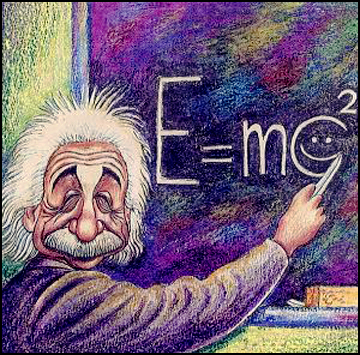
    The energy of this interaction creates mass and quantum gravity.  E=mc2 demonstrates the equivalence of mass and energy. 

    The strong nuclear force is the energy holding the three quarks together, while the weak nuclear force changes up-quarks into down-quarks or vice versa. 

    A rapid change of charged particles into lower or higher voltage occurs during a process known as quantum chromodynamics. 

    The action happens at the speed of light and creates enough excess gravitational energy to attract other quarks. 

    When two up-quarks and one down-quark combine, they form a hydrogen ion. After capturing an electron, it becomes a hydrogen atom. 

    Then clouds of hydrogen atoms attract other atoms using the quantum gravity produced by energy. The force of gravity is additive, and when enough quarks are attracted to each other, the energy causes a nuclear reaction creating a star. 

    The universe becomes illuminated by light. You can find more information in my book, Einstein: Distorted By Gravity. Look inside the book.

    How Did the Invisible Become Physical?

    Invisible light transitioned into a plasma of quarks, gluons, and electrons. Quantum fluctuations transformed the quarks into protons, and after electromagnetically capturing an electron, they became hydrogen. 

    Hydrogen is in stars and is the most abundant matter making up 73% of the universe. Stars and the energy of gravity create all other matter. 

    That’s how invisible energy became visible matter. It’s alarming that scientists haven’t studied the invisible energy of gravity, instead of thinking gravity is the curvature of space.

    There’s no reason for the Church to be alienated by science. All science and all energies come from the same invisible source that created and evolved into the universe. 

    It’s time that the Church realizes that the invisible forces are scientific facts and that scientists realize the energies are invisible forces of the universe.  

    More importantly, everything comes from our non-physical source, and neither the Church nor Science can claim to own or control it.

    Science should study how invisible forces create matter and life, and the Church should teach how our soul is connected to consciousness. 

    The Bible should be a spiritual lesson that teaches us how to evolve our consciousness instead of preaching what not to do. 

    The lack of vision has prevented science from learning the truth and slowed the evolution of consciousness. Religion without science is incomplete, and science without spirit is blind.


    Always use your discernment before accepting anyone’s beliefs. My point of view looks outside of the box that scientists are scratching but cannot penetrate. 

    The Earth will enter a golden age when we understand consciousness and how it works. Without spiritual energy, our planet will fail to evolve. Thanks for sharing your valuable time with my newsletter at https://lovinthings.com/. Use the science in your life to be well, keep your mind open to all possibilities, treat everyone with respect, and be happy. With love, Erik Lovin xoxo.

  • How Did The Younger Dryas Event Touch Us

    How Did The Younger Dryas Event Touch Us

    How Did the Younger Dryas Touch Us

      The Earth has witnessed its share of meteorite strikes. However, most of them have been eroded and covered over by vegetation. Look at the moon’s surface to see how many craters the Earth might have. 

    Asteroids have caused mass extinctions and loss of life in Earth’s history. 

    Meteorite impacts cause huge environmental changes, extreme weather, volcanic activity, and rapid climate change. 

    For example, two big events occurred near my home in Canada. 

    The Manicouagan Crater in Quebec was formed by an asteroid strike over 214 million years ago. The crater is one of the oldest known impact craters. It’s in the Côte-Nord region of Québec and is thought to be from a 5 km diameter asteroid event 215.5 million years ago. 

    The Manicouagan crater may have been part of a multiple impact event that also formed the Rochechouart crater in France, the Saint Martin crater in Manitoba, the Obolon crater in Ukraine, and the Red Wing crater in North Dakota. 

    These five craters form a chain, indicating an asteroid or comet’s breakup and subsequent impact. The chance that these craters could be aligned like this accidentally is nearly zero. 

    The Sudbury Basin, also known as Sudbury Structure or the Sudbury Nickel Irruptive, is a major geological structure in Ontario. 

    It’s in my city and is the third-largest known impact crater on Earth and one of the oldest, occurring 1.8 billion years ago.

    Low Global Temperatures Cause Ice Ages.

    Several mass extinction events have reduced life on Earth dramatically. It’s estimated that 99% of all the species of plant and animal that lived are now extinct. 

    During an ice age, colder global temperatures lead to recurring glacial expansion across the Earth’s surface. 

    These periods can last thousands or millions of years, along with regular warmer interglacial intervals in which at least one major ice sheet is present. 

    Global cooling periods begin when a drop in temperature prevents snow from fully melting in some areas. 

    The bottom layer turns to ice, which becomes a glacier, as the weight of accumulated snow causes it to move slowly forward. 

    A cyclical pattern emerges in which the snow and ice trap the Earth’s moisture, fueling the growth of these ice sheets as the sea levels simultaneously drop for lack of water. 

    Earth is currently in an ice age, as the Antarctic and Greenland ice sheets remain intact despite moderate temperatures. 

    It’s worth mentioning that the increased CO2 caused by humans has a minimal impact on the climate. Currently, the industrial revolution adds CO2 into the atmosphere, but not enough to cause dramatic climate change. 

    However, the Earth’s magma is warming, causing the current melting of Earth’s glaciers from the bottom up. 

    Many significant ice ages happened in Earth’s history, with approximately a dozen epochs of glacial expansion occurring in the past one million years.  

    The Top Five Glacial Extinctions on Earth.

    1. Cretaceous-tertiary Extinction 65 million years ago.
    2. Ordovician-Silurian Extinction 440 million years ago.
    3. Devonian Extinction was 365 million years ago.
    4. Permian-Triassic Extinction 250 million years ago.
    5. Triassic-Jurassic Extinction 210 million years ago.

    The Largest Extinction on Earth

    The prehistoric ages had many extinction events. The Permian Age extinction 250 million years ago is believed to have wiped 95% of life from the planet. 

    Catastrophic conditions created a low-oxygen atmosphere, high temperatures, extreme fires, and acid rain. In this prehistoric period, it’s unknown what caused these conditions. 

    For one million years, volcanic eruptions spewed over 300 million square kilometers of lava. The earth was sent into intense global warming as the Earth grew hotter. 

    This triggered frozen methane under the ice to melt. Methane is 20 times a more potent greenhouse gas than C02. 

    Global warming accelerated, leading to 85% or more of marine life becoming extinct, as well as 70% of land vertebras. The prehistoric Permian Age extinction vastly shaped life on Earth.

    The Dinosaur Extinction Event

    Sixty-five million years ago saw the complete disappearance of the dinosaurs from the planet. During this period, 50% of all plant and animal life on Earth died off. 

    The event marked the end of the Cretaceous Era and the start of the tertiary period. For a long time, scientists didn’t know what had triggered the dinosaur extinction. 

    Theories included volcanoes and plate tectonics; however, in 1980, the meteor impact theory was presented. 

    Evidence was discovered in Northern Italy in a sediment layer, indicating an impact dating to 65 million years ago. 

    More data was found in New Zealand and Denmark of a rare and space-associated element, Iridium. The platinum group metal is located on the earth at 0.3 parts per billion, but the iridium-rich layer had 9.0 parts per billion or higher. 

    This sparked debate as to an asteroid origin of the iridium-rich findings. The layer corresponded directly with many dinosaur fossils already uncovered. 

    However, the theory was not widely accepted because scientists couldn’t locate a crater to match their findings. 

    It took ten years of further research to uncover the crater near the Yucatan Peninsula, which dated to 65 million years ago. It directly matched the Iridium layer and confirmed the main cause of the dinosaurs’ extinction.

    The Younger Dryas Event

    A much lesser-known and more recent extinction touched the rise of our current civilization. 

    This near-glacial period is called the Younger Dryas, named after a flower (Dryas octopetala) that grows in cold conditions and became common in Europe during this time. 

    Let’s explore the relationship between this event and the rise of the current human civilization. 

    Scientists are studying the 1,200-year cold period known as the Younger Dryas. 

    The Younger Dryas Event is our most recent mass extinction causing 75% of northern animals to disappear. 

    About 13,000 years ago, the end of the last ice age saw the dawn of our civilization. 

    Then a large meteorite landed on the glacier ice field in Greenland, causing a catastrophic event.  

    It’s a geological time when dramatic changes happened across the earth. The rapid melting of the North American ice sheet meant global sea levels rose almost 100 feet. 

    Wildfires consumed most of the vegetation, sending black smoke into the air, and the Earth was enveloped by dust and ice crystals blocking the warmth of sunlight. 

    After this period, humans controlled the land because large animals, including the wooly Mammoth, giant Beaver, and northern Lion, went extinct.

    The Mystery of the Younger Dryas Period

    The Younger Dryas period is still a mystery. Evidence suggests sudden large animal extinctions during the period. Roughly 120 species of mammals became extinct. 

    This spike is documented by fossil remains that coincide precisely with the melting of continental glaciers, rising sea levels, and temperature changes worldwide. 

    The mass extinction of animals is responsible for the beginning of human farming.

    The Disappearing Human Population

    Besides, animal extinctions are the loss of ancient human societies. 

    The indigenous native people in America (Clovis culture) disappeared during the Younger Dryas period, and it coincides directly with the extinction of North American animals. 

    One theory suggests the extinction happened due to humans hunting large mammals. However, fossil records show humans vanishing at the same time. 

    Human remains continued to decrease after the Younger Dryas period. For 3000 years, the Younger Dryas changed our lives as fewer archaeological records of humans were documented. 

    The period ended with an unknown event that quickly warmed the planet. 

    As the ice melted, the earth was ready for farming and the rise of human society. Precisely what caused the sudden change is still unclear.

    Four Possible Causes of the Younger Dryas Event

    Both rapid global cooling and rapid warming highlight the Younger Dryas Event. 

    From 17,000 years ago, the earth transitioned from the recent Ice Age. But about 12,800 years ago, the earth was thrown back into full ice age conditions during the Younger Dryas. 

    Labeled a mini ice age, these conditions lasted for 1,200 years until the earth violently warmed again, and the huge ice caps decreased quickly. 

    Why did the North American animals and indigenous people of the Americas (The Clovis people) disappear?

    1. The Younger Dryas Comet

    There is strong evidence that a comet impact triggered the Younger Dryas. The hypothesis has been gaining momentum for over ten years. 

    Archaeological sites worldwide are revealing iridium-rich samples in the soil dating to the Younger Dryas period. 

    But like the search for the dinosaur extinction, researchers lacked a crater until recently. 

    A crater was recently discovered near the 58 million-year-old Hiawatha crater in Greenland. 

    It all makes sense when we look at these occurrences in the context of the impact hypothesis.

    2. Global wildfires

    Like previous mass extinctions, the evidence reveals conditions that would make life difficult.

    Continent-wide wildfires are suspected of burning as much as 10% of the earth’s biomass and are found to begin at the onset of the Younger Dryas period. 

    The evidence lies in the sediment dated to this period, which scientists call the ‘Black Mat’ layer. 

    The evidence is spread over 50 million square kilometers, dating to the Younger Dryas’ catastrophic period. Further impact scars are scattered across North America.

    3. The Sea Level Rise

    During the Younger Dryas, global sea levels rose about 100 feet, submerging millions of square miles of land. 

    Two distinct melting episodes brought unprecedented floods. Also, the North American ice sheet disappeared so fast that scientists can’t explain how it happened. 

    Geologists are now mapping the North American landscape and showing scars from the Younger Dryas. 

    Did the scars happen from smaller pieces of meteoroids or the Greenland crater impact that sent large blocks of ice flying and crashing into the landscape?

    4. The Long Term Global Temperature Change

    The global temperature remained ice age cold for 1,200 years and suddenly returned to normal. 

    The Greenland ice and vaporized water would have been sent into low Earth orbit, forming ice crystals preventing sunlight from reaching Earth. 

    The sudden return to a normal climate can be explained by the ice crystals eventually sublimating into gas, allowing sunlight to warm the planet. 

    Solar flares or other events could have helped the rapid warming ending the Younger Dryas event.

    In Summary:

    While we often see Earth’s history as a gradual evolution of the environment, the reality is that significant changes happen faster than we thought. 

    From the dinosaurs to earth-wide catastrophes that nearly ended all life, extinction events have shaped planet Earth. 

    Science takes its time to build evidence proving these extinction events happened. 

    The Younger Dryas Event caused many animal species to go extinct quickly. It’s one of the most significant mass extinctions the Earth has seen in millions of years. 

    Besides this, the decline of human societies due to disastrous conditions has been confirmed. 

    The Younger Dryas event ended the late prehistoric age as the earth moved into its current cycle. 

    It marks both animal and human population decline that occurred at the rise of the current human civilization. 

    Until now, these events have been viewed in isolation from one another. Once pieced together, it’s easier to understand how Earth’s conditions touch our lives. 

    The last great mass extinction from 12,800 years ago brings us the world we see today.

    I’m happy you read my weekly newsletter here https://lovinthings.com/, where I examine articles and look for a different point of view to explain what still needs to be explained. I use logic to make sense of events. 

    My out-of-the-box ideas offer logical explanations that scientists can’t make, even though they often make theories without logic. But before you accept anyone’s ideas, always use your discernment. 

    Thanks for being here. I’m always grateful and appreciate your input. Be well, and take care. With love, Erik Lovin xoxo.  eriklovin@gmail.com