Use your imagination and try to picture this: clocks haven’t been invented yet. What did people in ancient times think about time?
They probably lived simple lives in tune with the sunrise and slept when it was dark. If it was cloudy or raining, they may have stayed in bed longer or taken naps during the day.
Defining time isn’t easy. Does time have a single meaning, or can it represent various things that exist separately from clocks?
Historically, time was viewed as the sun moving across the sky, followed by nighttime. The daily pattern of light and darkness manifests as our sleep-wake rhythm. Is this daily cycle our experience of time?
The earliest way to see time was from a sundial, which showed the dial’s shadow move across the surface on a sunny day. As humanity progressed, we sought ways to measure time more accurately.
A Brief History of Time Accuracy
Timekeeping took a major step forward in 1283, when the first weight-driven mechanical clock was invented in England. It was accurate to about 15 minutes per day.
Time was based on Earth’s rotation of 12 hours of daylight and 12 hours of darkness. Each hour has 60 minutes, and each minute has 60 seconds.
The calendar became an important indicator of the passage of time, which allows us to write about historical events. The 1,600-year-old Julian calendar had drifted 10 days out of sync with the solar year because a year isn’t exactly 365 days long.
The modern calendar, known as the Gregorian calendar, was introduced by Pope Gregory XIII in October 1582. It was designed to correct inaccuracies by using a leap-year formula to track the days more accurately.
In 1657, the pendulum clock was the first accurate clock, losing only one minute per day. It was based on the motion of a swinging arm. Heavy weights hung from chains that turned the gears in the mechanism to move the minute and hour hands around the clock’s face.
The first clocks were placed in a church steeple, and a bell would ring each hour, the number of times matching the hour. If you wanted to know the time of day, you had to listen and count the number of rings.
The digital age began with the invention of quartz technology in 1927, but it wasn’t put into practical use until Seiko introduced the first quartz wristwatch on Christmas Day, 1969. A tiny battery vibrates a quartz crystal, and the mechanism counts the vibrations until they total one second, equivalent to a pendulum clock. Digital watches are accurate and still in use.
The next generation of timekeeping was based on atomic oscillations. In 1955, the first precise cesium-133 atomic clock was built, providing superior accuracy over quartz clocks.
Thus, in 1967, the atomic second was officially defined as the time it takes for a cesium atom to oscillate 9,192,631,770 times. Such a clock is accurate to the second for several million years.
A second was previously defined as a fraction, 1/86,400 of a mean solar day, but the astronomical definition was abandoned because Earth’s rotation is not perfectly constant.
Also, the duration of a year isn’t exact, so every four years, an extra day is added to account for Earth’s orbit. Moreover, many countries use daylight saving time to lengthen the hours of daylight.
Our timekeeping methods are adjusted to suit our needs. When we adjust clocks, are we changing the clock or time itself? Can we describe time without using clocks?
A Description of Time
Time seems to have two parts. The first part comes from seeing trees bending in the wind, birds flying, and the sun moving across the sky. The second part is what we feel with our senses.
While we sleep, we hear our heartbeat, feel the air enter our nose, and sense our chest rise and fall. When we combine these feelings with the visible movement, we believe that everything is moving…
Clocks count the oscillation of atoms, and they let us measure the movement and speed of all things. Is time a physical thing, like the movement we witness, or a concept based on clocks?
We observe that time has many aspects that affect our lives, but it’s not easy to define. Is time a measurement or a force that moves things?
Our definition of time came from Earth’s rotation, and now it comes from atoms. Does time exist in everything? The Sun keeps shining, the Earth keeps spinning, but what exactly is time?
We began by imagining a world without clocks, watching the sun move across the sky. We created clocks from moving gears and pendulums, and now from the energy in atoms. In every era, we fine-tuned the movement of things into clocks with greater accuracy.
We live on a spinning planet with our beating hearts and vibrating atoms. However, there’s one final question… What are clocks really measuring?
The human situation regarding religion and politics is in utter chaos and bordering on anarchy. I don’t know much about politics or economics, but I understand the purpose of life.
Only a few realize how religion and politics can control people and create chaos. Please use this information only for entertainment purposes.
Two thousand years ago, a group in Rome noticed that people started following the teachings of Jesus. The powerful sect took notice not for religious reasons, but because they realized its ability to control the masses.
The historical expansion of Christianity raises this question. Why did Rome send priests to colonize and spread Christianity worldwide? On the surface, teaching Christianity and the word of the Bible seems noble. However, an ulterior motive was to gain power and riches.
Within a few hundred years, the Church held power over governments, but the truth is much darker. A few individuals conspired to control the Church and rewrite the Bible to gain power over humans. Such a secret group is called a Cabal.
What is the Cabal?
The Cabal is a mysterious group that controls the government and the Church using the power of religion or other means. It’s a sect that may include non-humans and elites. The UFOs that humanity has witnessed belong to the aliens, but they are not extraterrestrial. The aliens are the grays or reptilians who have been living beneath the ocean or the Antarctic ice for far longer than humans have been on Earth.
The Cabal realized that no one would go against the church because the Bible is the word of God. If people disagreed, they were eliminated as heretics. Women were burned at the stake as witches, and wars became holy wars. Namely, the words in the Bible were translated into the ultimate power.
Eventually, each country used a version of this power. England, France, Spain, Italy, and Portugal sent missionaries to spread their religions worldwide. The purpose at first was to explore what the Earth looks like and to search for riches worldwide. But the Cabal was familiar with the world, and they wanted to extend the power of religion to every country.
For example, Spaniards invaded Mexico and looted its riches for the organizations that funded them. England did the same, monopolizing the resources of many countries. In modern times, America has established a global presence in many countries.
Behind the veil, the Cabal controls everything… Islam is an alternative religion that emerged in the 7th century and centered around the teachings of Muhammad.
The Quran is the sacred book of Islam, like the Bible is to Christianity. However, it was written about 300 years after Muhammad died. Christianity is divided into many versions worldwide, while Islam contains two sects.
The Shiite Muslims are controlled by the Cabal, and they changed Islam into a different version. The main goal was to eliminate Jews and gain control of religion in the entire region. They changed the narrative from living for God to dying for Allah. This belief is the basis for terrorists to take control of the world, until every country is Islamic.
Islam controls people’s minds through the frequency of their thoughts. Every day, Muslims must pray in groups, five times a day, but they don’t pray for personal things. Using group prayer, they pray for power over non-believers of Islam. It’s well known that group meditation affects people’s minds.
The Cabal controls this group, and they want chaos, war, and death instead of peace and love. Why? Chaos prevents humans from evolving. History shows that wars are fought over religion. The Great World War was also orchestrated by the Cabal. They offered Hitler control of Europe if he eliminated the Jewish population.
The good in humanity prevailed, and the State of Israel flourished. Now, terrorists are trying to destroy the Jews and conquer the world with ads promoting fake news to gain sympathy and assistance from people worldwide.
Wars are fought for power and wealth, but the Cabal manipulates groups to fight wars to prevent people from spiritual evolution. The Cabal likely also manufactured the Covid-19 virus to quell the population.
Their greatest weapon is using fear to control people’s minds. People are ignorant of the Cabal, so their minds are led like sheep. The Cabal causes chaos to control and motivate people into anarchy.
Since the Cabal doesn’t need wealth, they use money to manipulate others. For instance, an organization in New York pays people to join riots and cause chaos. Their goal is to keep the population from knowing their true power. When the world is fighting, people don’t have the resources or time to focus on spiritual growth.
The duality of life means that the opposite of everything exists. Our journey is to overcome opposing forces, face our demons, and evolve despite obstacles. The question remains: what can we do with this information?
The Cabal is orchestrating the “Free Palestine movement” to control people whose minds are full of struggle, despair, and negativity. People who have no purpose will join any group of protesters, especially if it helps starving babies. Being in a group of like-minded individuals gives them a sense of purpose.
The reality is that terrorists use lies and propaganda to blame governments for the chaos that they themselves create. The media believes their lies, while some members of the media are paid to promote the fake news.
The world sees disturbing videos filmed by actors and then declared as news. Thus, good people cry out and believe the news, without knowing they are supporting terrorists. The Cabal continues to keep people from knowing they have souls connected to God’s consciousness.
The only way out of this mess is to educate yourself that death doesn’t exist. Souls do not die. The purpose of life lies in each person’s evolution of consciousness, and the aliens who lack souls fear this power.
Reincarnation is the answer to death. No one gets out alive, and no one ceases to exist. We can’t escape the truth that humans are souls connected to God, so why fight with ourselves? However, the aliens know that humans cannot be eliminated because souls never die.
Humanity must wake up from the illusion of death and rise above hatred and racism. Check out this book, Humanity’s Forgotten Origins, on Amazon. It explains why various races and religions are on Earth. Our purpose is to evolve consciousness while living in a world of duality among other races and religions.
The Difference Between Spirituality and Religion
The church uses a Bible or another religious text to offer members a roadmap. Follow these commandments, do this, not that. If you don’t follow the rules, you will end up in a terrible place.
However, spirituality depends on your divine being, the soul. It offers enlightenment and curiosity to question all beliefs. It challenges you to discover that what you are seeking is within yourself: truth, peace, love, and the very essence of God.
Souls have free will to do whatever they want, but ask yourself, what do you want to do with your life? Don’t give away your power to groups that use you for their own agenda. Always help yourself before helping others. The truth isn’t in the world; it’s within each person’s soul.
Your goal is to recognize the soul’s voice speaking to you in the silence of your thoughts. That’s who you truly are. Make the best choices for you and your higher mind, and beware of anyone or any group who uses your consciousness and energy for their own ends. However, don’t believe everything you read… Namaste at https://lovinthings.com/
Time is difficult to define because we have a special relationship with it. Prepare to realize what no one has mentioned: time lives in us. Time isn’t a single thing; it contains two parts: first, we observe things moving, such as birds flying and trees moving. The second part is what we feel with our senses.
As babies, we rest, and feel our heartbeat, the air moving in our nose, and our chest rising and falling. When we become self-aware, we combine awareness of motion with the perception of objects moving and conclude that everything moves. Are you following how we grow up and become aware of our environment?
Is time derived from motion, and related to our awareness? A clock shows time, but wait a minute, let’s go down the rabbit hole further…
Can time be measured?
Do clocks measure time? No, we can only measure motion, and then we convert a clock’s numbers into time. Numbers and time are not physical things. The visible motion we witness is absolute, and clocks are objects. A clock counts its ticking as seconds, and each second is equal to the movement of Earth’s rotation.
Time has many aspects that affect our lives, but in reality, time as we know it is a concept. Moreover, what we experience as time doesn’t exist in nature.
However, in our modern world, we can’t function without clocks to show us the time of day. We have invented clocks and time, and now we are held accountable to a concept that controls our lives.
It’s challenging to describe time because we label things with our concepts of time, such as memories, moments, and travel. Do we understand time? People believe that, given enough time, anything can happen, and without time, nothing can.
People think that the Sun moves across the sky. Some believe we can move in slow motion or at nearly the speed of light, while time continues to move, making us older.
Scientists think that time exists alongside the other forces of nature. I can relate to this idea: “I think, I am, so time exists.” However, “time” and a clock’s time are two separate things. Universal laws affect matter, not time or space.
Our most significant misconception is thinking that time has the power to change physical things.
How Does Time Benefit Humanity?
Timekeeping is necessary for humans to thrive in a modern society. But we should realize that time doesn’t have physical qualities. It exists only in our beating heart and on timekeeping tools. Time is only a number on a clock, a historical event on a calendar, or a future appointment.
Time has no power to change anything; a clock can slow down or speed up, but it cannot make you older or younger. We count our age by how many times we circled the Sun.
We are souls experiencing life in a body, and our “time” ends when the physical and emotional stress of living stops our beating hearts.
Our Perception of Time
The planet’s daily rotation has a rhythm of sunlight, temperature, and ocean tides that affect us. Circadian rhythms are the daily cycles of the body’s internal clock, which runs in your mind and carries out essential functions and processes.
One of the most necessary and well-known circadian rhythms is the sleep-wake cycle. The body’s circadian rhythm is linked to your internal clock in the brain’s hypothalamus.
We base our perception of time on Earth’s daily cycle. The circadian rhythms of light and darkness are stored in our brains and control our daily activities. When we sleep, our hearts beat about 60 times per minute. It’s not a coincidence that our clocks tick at the same rate as our pulse.
We made clocks to tick 60 times per minute instead of, say, 100 times per minute. Thus, clocks and hearts tick 80,400 times per day. Think about that… we measure the speed and duration of everything in the universe based on the beating rate of our hearts.
Was the universe created for us, or did we adapt to the cycles of Earth’s rhythm? Either way, we are trying to understand our experiences and ourselves by our heart’s pulse. Don’t you think that’s amazing…
We feel and see motion, and we think of it as time passing, but it’s the motion moving in and around us that’s passing. However, most of us live in a matrix, believing that time moves.
Will we wake up and realize the truth about time? Nature doesn’t use time; the Sun keeps shining, the Earth spins, and we keep asking what’s the time? Are we there yet? How much longer?
Our Changing Awareness of Time
Clocks don’t exist without humans, and only clocks show the time… We have lost our natural cycle of seeing and feeling time pass, and now we rely on timekeeping tools for daily events.
A clock can tick faster or slower, but the universe has an absolute age that expands at the speed of light, from the Big Bang to this present moment. Motion moves. Time doesn’t move. Time can’t be measured because a clock counts seconds, which are already measurements.
Clocks tick at the rate of our beating hearts; we call it time, and then measure everything else in the universe with clocks ticking at the rate of our hearts.
It’s fantastic to know that time lives in us, yet the revelation is that we have allowed clocks to take over our natural ability to sense time.
Are you living in the Matrix? Be patient, realize your relationship with time. Give time a chance, and I promise, the light will wake you up… Thanks for your time and awareness at https://lovinthings.com/.
Does light and its color shape your mind? Discover the possibilities and get ready to unlock the wonder and beauty of every ray of sunlight unique to you. When you look at color with intent, it reveals the beauty of nature that casual observers miss. Why is the sky blue? What colors do you see in a sunset?
The colors that you see show the profound beauty that makes your vision special. The more you learn about color and how it resonates with you, the more it awakens your wonder and awe.
Optometrists know that people see color differently. When you look at color, realize that your eyes are unique. Color and its properties can increase your potential for fashion and art because the emotions associated with specific colors affect you.
The physics of light and color is a pathway to deeper cognitive understanding. Knowing how light works means knowing how your brain works. Being enlightened is all about light, and the science behind color is valuable not only for art and makeup.
Knowledge of everyday experiences, such as sunsets, rainbows, and photography skills, can be applied to art, design, or social media aesthetics.
The science of color can change how you see every painting, every sunset, and every rainbow in your life. Learn the secrets of color perception, emotional well-being, and the science behind beauty.
The Physics of Light and Color Gives Us Vision
Let’s dive into how light and color interact with the brain to understand why your vision is unique. Light enters your eyes and passes through the cornea, which is the transparent front layer of the eye. Its dome shape helps bend light, allowing the eye to focus.
Light enters the eye through an opening called the pupil. The iris, the colored part of the eye, controls how much light the pupil lets in. Next, light passes through a clear lens in the eye. This lens, along with the cornea, focuses light onto the retina, a light-sensitive layer of tissue at the back of the eye. Its special cells, called photoreceptors, turn light frequencies into electrical signals.
Electrical signals travel from the retina along the optic nerve to the brain. Finally, your brain turns the frequencies into the images we see. People have slightly different eyes and brain cells; therefore, everyone’s vision is somewhat different.
To Be or Not to Be
Every human has a connection to an unknown energy. A common quote is: “What came first, the chicken or the egg?” It’s like asking what came first, the pregnancy or the baby. How about what comes first, a thought or a vision? Energy created the universe, and life emerged from that energy. Before the universe or a chicken can exist, a mind must exist. To be or not to be, that is the question!
Since we are asking the question, we are alive. If you are not living, you are not alive; life doesn’t exist for you, but your soul exists in another dimension. In that nonphysical world, no form exists, but the energy of every Soul does. Think about that for a minute…
In our physical universe, we view the outer world as matter, unaware that our bodies are part of it. However, our universe also has an outer world, and our higher mind connects to that consciousness, which is teeming with mindful expressions.
Those unseen thoughts are the least important in life, but they are the reason you are unique and special. Life is a physical expression of consciousness. In each lifetime, we experience consciousness in this physical world, but we always return to our Source of consciousness.
Life is like being in school and experiencing consciousness. When we graduate, we leave this imaginary school. Would you fear dying if you knew you would return to your eternal Soul?
Photons are Quantum Energy Packets of Light
The physics of color and how your eyes see the world starts from the light source. White light has a frequency of 750 terahertz, yet it isn’t in the visible spectrum. Isn’t that interesting? Is that why we say white isn’t a color?
Visible Light can have many different frequencies, but white light has only one. The color cones in the eyes of all insects, animals, and humans detect light frequencies, not wavelengths of color.
Light consists of the smallest quanta of energy, a photon. Photons travel using electromagnetic frequencies, carrying quantum energy. Each photon in the electromagnetic spectrum has a specific quanta of energy, depending on its frequency. It seems we need a better understanding of light and its color…
Classical Physics Meets a New Horizon of Light
Classical physics tells us that light has a frequency and a wavelength. However, since light is quantum energy in motion, it’s not just a particle or a wave. A photon is the smallest form of energy, and its energy depends on its frequency.
Knowing how light and color interact with the environment is tangible evidence that your visual experiences are unique.
The physics of light shows that we interpret colors using the visual cortex and the brain based on light’s frequencies. Objects have frequencies, not colors. Electrons emit photons, and the color of a photon depends on the electron’s frequency.
The intensity and energy of sunlight are blinding, so an object’s electrons filter white light into lower visible frequencies. When a light source illuminates electrons, they emit “electronic light” that lets us see the world. We are fascinated by colors, unaware that the frequency of light determines the color.
Your Relationship with Light
The physics of light’s frequency reveals the magic of your vision. Notice how you feel when you see a specific color, and note the environment and the source of the light. You can sense each experience of light in new ways.
Imagine if color could increase your mental clarity, translating to smarter social interactions, more insightful conversations, and being seen as intelligent and well-informed. How light interacts with your brain gives you tangible knowledge to understand your visual sensations.
Play with light and use it to feed your inner world, your soul, and your mind. When you pay attention to the light, you become enlightened in ways that are indescribable by words. Go outside, feel the sunshine, and experience your colorful and fascinating vision.
My new book will be about light and the physics of vision.
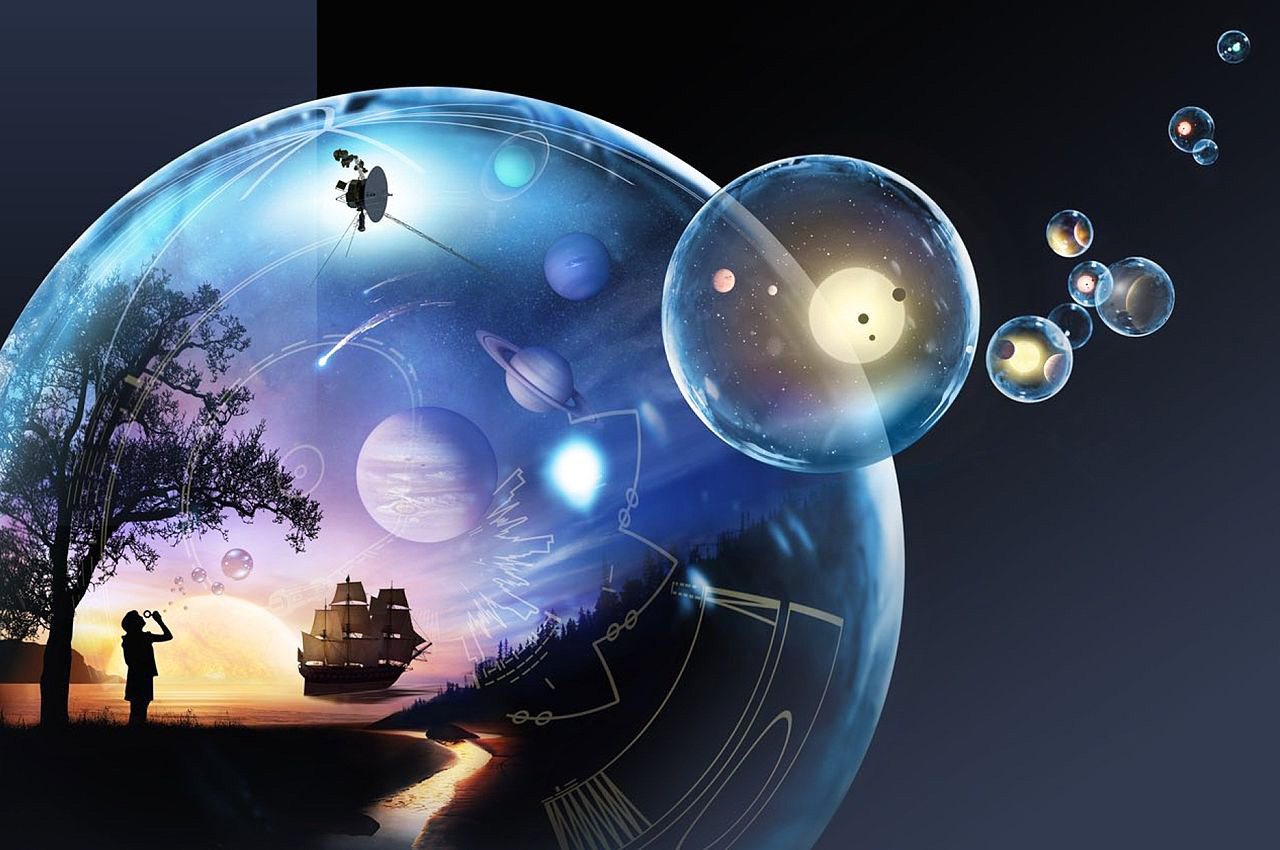
Our universe doesn’t exist independently; it’s part of the infinity of our Source. The universe was squeezed out from the Source of infinite energy like a bubble appearing from nowhere.
Picture this: A bubble emerges in a glass of beer, expanding into a perfect sphere enveloped by the liquid. Imagine the universe as the bubble and the Source as the infinite liquid surrounding it. Does that spark your imagination?
The universe isn’t a single system surrounded by space. The universe is like a bubble within infinity. When the bubble pops, it ceases to exist, but all the energy remains in the infinite Source. This analogy helps us understand the universe as a localized entity within an endless expanse, similar to a bubble in a vast ocean.
Consider that when electrons gain energy, they create light. However, creating a bubble of energy from the infinite Source required lowering energy. In the infinite realm, high-frequency energy underwent a phase transition into lower-energy states, separating from infinity and forming a bubble of energy that transformed into the universe.
However, the universe is still within and surrounded by the infinite Source. Then the energy changed into electrons and a plasma of quarks and gluons. Quarks are the fundamental building blocks of the universe and the source of gravity. These tiny quantum particles operate at immensely high frequencies.
Mass emerges from the synergy between quarks and gluons into hydrogen, while gravity emerges from quantum chromodynamics. Gravity pulls hydrogen gas into large balls, triggering nuclear fusion reactions; thus, light illuminated the universe.
Creation continues as the massive stars die in violent supernovas, forming heavier atoms, smaller stars, and planets. The Bubble container continues to expand towards infinity from which it came.
To better understand the expanding universe, imagine a balloon expanding as air is pumped into it. When the universe emerged from the infinite realm, it popped out, traveling at the speed of light into the expanding bubble.
The energy expands throughout space, while the universe is surrounded by the infinite Source. During the expansion of space, energy forms into levels of decreasing frequencies. The energy levels correspond to the four phases of matter: solid, liquid, gas, and plasma.
The Physical Dimensions of the Universe
The 4 physical dimensions of the universe are surrounded by infinity.
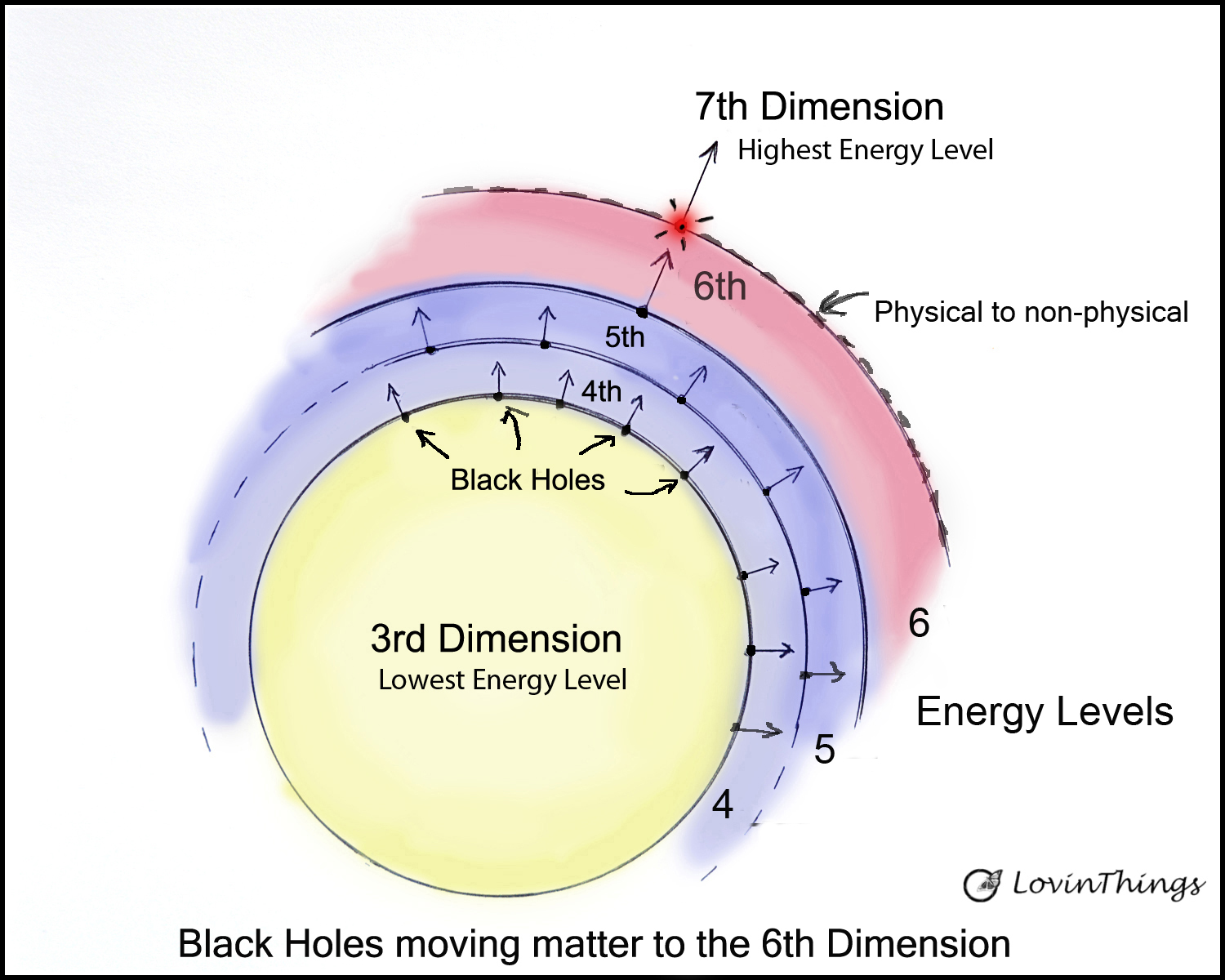
I use four colors to describe the energy dimensions. Yellow is the lowest-energy frequency and represents the 3rd dimension, where most of humanity resides. The 4th dimension has greater consciousness and is light blue. The 5th blue dimension has a frequency available for ascension (an important topic), and the red 6th dimension has the highest frequency of physicality.
All dimensions begin increasing their frequencies toward the red color at the bubble’s surface. When enough energy reaches the red level, a quantum fluctuation causes a phase transition, and the bubble pops as the universe disappears into the Source from which it came.
What Created the Universe?
Religions say God created the universe, but they don’t want us to know the truth. God has nothing to do with religion. God is pure consciousness, which is connected to each person. Religions prevent us from evolving by saying the Bible contains the word of God…
Religions preach, but they don’t teach. They don’t want us to know that we are spiritual beings with God’s consciousness. Humans are now awakening to our purpose: to evolve consciousness. God’s consciousness is in the universe and our souls, not in a church.
Understanding ourselves means understanding God, and we need to know that we are spiritual beings. It’s time to transcend religion and claim the power of our true consciousness.
A spiritual hierarchy exists where God is infinite energy. God desired company, so God divided energy into Spirits, who created the universe. Then, spirits created Souls, and souls created humans. Our purpose as souls is to use spiritual energy to evolve consciousness.
The name God means the Oneness of all and the Source of everything. God is pure thought and Consciousness that filters down into all levels of consciousness. The Source provides the energy and intelligence that steps down into lower vibrations of consciousness.
There is nothing greater or beyond God’s infinity. If you are curious, ask, “Is This All There Is?” Your purpose is to show God how you can evolve consciousness.
Was the Universe Created for Souls?
Have you ever considered why the universe was created, and if it has a purpose? Imagine that you are one of God’s Souls. The truth is that Spirits created the universe, and we are here experiencing and learning how to use spiritual energy.
You can extrapolate that God was the Creator because God created spirits. Ultimately, the universe materialized from God’s desire to understand consciousness, to know itself, and to evolve. When you think about it, that’s the same thing we are doing.
The infinite Source surrounds the universe and monitors souls as they experience and evolve consciousness.
Souls have a spiritual body embodying “The I Am Presence.” Ask not what consciousness can do for you. Ask what you can do for consciousness.
We are Messengers for God
When you ask, “Is this all there is?” Try to understand your soul’s purpose in this lifetime. Einstein said, “Two things are infinite: the universe and human stupidity, and I’m not sure about the universe.”
What man calls science, religions call God. We are not here to worship any god or prophet. We are seeking experiences that help God to understand his infinite consciousness. Additionally, we are learning to become greater souls than we can imagine.
Blend your spiritual body and mind to be messengers of God. With our experiences, we evolve our Souls and contribute to God’s consciousness.
In our search for meaning and purpose, our ultimate goal is to activate our spiritual power and become authentic humans. What’s preventing you from realizing your true spiritual identity? Namaste from Science in Your Life, helping you at https://lovinthings.com/
Space is the medium for everything visible in the universe. When we say we live in the 3rd dimension, we don’t think of dimensions as the invisible medium around us. Perhaps even the universe is a dimension within a greater realm. At the beginning of the universe, before galaxies existed, the universe’s raw matter of hydrogen and helium formed into giant gas balls. The immense force of gravity triggered nuclear fusions, forming giant stars.
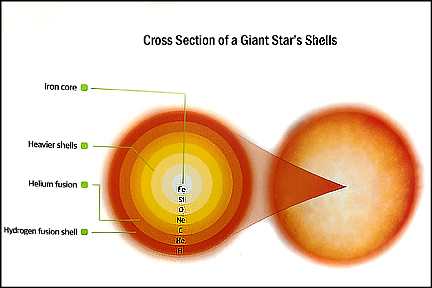
The theory is that these early stars created elements up to iron through stellar nucleosynthesis, a process in which immense core pressures and temperatures fused the lighter elements hydrogen and helium into progressively heavier ones, such as carbon, oxygen, and silicon, and finally iron, which marks the end of the process. However, we don’t know precisely how newly formed stars made heavier elements, but they did. Eventually, the generation of stars culminated in supernova explosions that produced the remaining elements and initiated the formation of planets and galaxies.
A giant star has shells of various atoms, and fusion stops when it reaches iron.
The nuclear fusion process continues making heavier elements until the star’s core is mostly iron. The fusion of iron isn’t possible, so the star has run out of fuel, and it causes a supernova reaction. Why? The outward nuclear explosions from the star’s core were in balance, with the inward force of gravity preventing the outer layers from travelling into the core.
When a star has depleted its nuclear fuel, gravity pulls the outer layers towards the iron core. The matter hits the iron core at speeds of 23% the speed of light. This triggers a supernova explosion that can cause a black hole.
What is a Black Hole and How is it Made?
Giant stars were, perhaps, billions of times the size of our Sun. During a supernova, most of the star’s outer layers are blown into space, leaving a black hole. A supernova is the most powerful force in the universe. When a star explodes, it sends most of the star’s outer material into space, and the heavier atoms in the periodic table are created and ejected into space.
But the exploding star has an equal and opposite force that implodes onto the iron core. Moreover, the iron core also collapses inward by gravity during the supernova. The result is that when these two massive forces act together, they create a black hole.
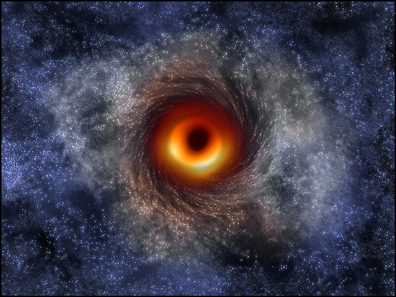
This is the first real photo of a black hole, released by NASA in April 2018.
During the iron core’s collapse and the immense implosion, a phase transition occurs. The iron core transitions to a higher frequency dimension. Such a dimension isn’t inside the Black hole or 3rd dimension because frequencies separate dimensions. Each time matter changes form, it requires energy to transition between phases. For instance, when ice transitions into water, water into a gas, or gas into a plasma, there is an energy barrier between the water phases. You can think of these energy barriers between phases as frequencies that separate dimensions.
A Black Hole is a portal into another dimension. Examine the diagram showing the mechanics of a phase transition.
A Black hole creates a tunnel into another energy level of the universe.
The event horizon is the point of no return. A phase transition changes matter into a higher-energy state. The membrane between levels keeps energies separate, but gravity is a long-range force that can “reach” our dimension. That explains why galaxies orbit the sources of gravity around Black holes.
The Universe has Dimensions of Energy
If you are skeptical about other energy levels or dimensions, consider where the Big Bang came from. If dimensions are “energy levels,” it’s easier to understand. The universe is 13.8 billion years old and began with the Big Bang; therefore, it’s proof that other dimensions exist.
A universe can’t start from nothing.
If you think the universe is eternal or materialized out of space in a quantum fluctuation… Then, where did the energy come from to create the universe? You can’t escape the fact that there is a Source dimension that supplies energy to the universe.
That source must be in a different dimension or realm with unlimited energy and intelligence. Black holes are a mini example of energy moving matter into another dimension. The Big Bang event released enough energy to create the entire universe, while black holes channel energy into higher frequencies.
The scientific proof is in the amount of matter in the 3rd dimension. Our dimension accounts for only 5% of the universe’s total mass and energy. Where is the other 95%? Black holes emit a strong gravitational field due to higher frequencies. Since our dimension accounts for only 5% of the total mass, the remaining 95% isn’t merely inside black holes. If the gravity were in black holes, the total mass in our dimension would be 100%.
The answer is that Black holes are portals into another dimension. Matter moves into Black holes and emerges from White holes into a higher-frequency dimension.
What dimension has the most energy?
The 7th dimension and beyond are nonphysical.
Black Holes and Dark Matter
Matter is attracted into Black holes, but it isn’t inside them. It means that the gravitational force from Black holes comes from somewhere else, namely, another dimension. Thus, Black holes are portals to another energy level, and the intense gravity emanating from them reaches us. Now, for the moment you’ve been wondering about… the matter that moves into Black holes is what we are calling dark matter… That’s why we can’t find any dark matter in our dimension.
Dark matter is ordinary matter that has gone into a higher energy level, and the long-range force of gravity reaches our dimension. As more and more matter leaves our dimension, we experience a stronger attraction towards that dimension.
The Purpose of Black Holes
The Universe needs Black holes because they create the structure of galaxies. Most of the matter ejected from a star’s supernova forms new stars and planets, which appear around Black holes. Additionally, Black holes increase the universe’s entropy by converting ordinary matter into higher-energy matter that changes to higher frequencies. The movement of energy is mistakenly referred to as time; however, it’s the evolution of energy returning to its source. The movement of matter into higher frequencies is the mechanism of change. Time is just the measurement of the motion we experience.
The Event Horizon
The size of the event horizon determines the size and strength of Black holes. The event horizon is a circular region around the Black hole that is said to be linked to the speed of light so that any object, including light, can not escape the region beyond the event horizon. However, the real reason light can’t escape is that the portal is a one-way tunnel. Matter, including light, moves into the portal and into the next dimension. Nothing can come back out except the force of gravity, which doesn’t have mass.
An Artist’s view of the event horizon is the black ball, representing the region of no return.
Time Dilation
Time dilation occurs in clocks near a strong gravitational field. The science-fiction definition means that if we could see a spaceship falling towards a black hole, it would happen in slow motion. The ultimate truth is that time doesn’t affect motion. Only the clock’s mechanism is affected. A spaceship moves at relativistic speeds, and we wouldn’t see anything because black holes are millions of light-years away from Earth. Learn the definition of time here.
Spaghettification
Spaghettification is a science-fiction concept invented by Stephen Hawking. His theory suggests that the force of gravity is stronger the closer you are to a singularity at the center of a black hole. He claims that if an astronaut falls into a black hole, he will be stretched and pulled apart because the force of gravity acting on his feet is much stronger than that acting on his head. However, Black holes are millions of light-years away, so we would never reach them.
Your body falling into a black hole gets stretched like spaghetti…
Hawking Radiation
In 1974, Stephen Hawking announced in a seminar that a Black hole could lose energy by blackbody radiation, get smaller, and eventually vanish. This has not been the case since more matter is constantly moving into Black holes. Hawking radiation doesn’t work because a Black hole isn’t like a regular blackbody that radiates energy. Scientists are still confused by the math and energy of Black holes because they don’t believe that other dimensions exist.
Black and White Holes
A Black hole appears completely black because even light disappears into the event horizon. A white hole is the other end of the portal into a higher frequency dimension. If we were in that dimension, we would see white lights in the night sky. When all the matter from the 3rd dimension is in the 4th dimension, the white holes would fade and vanish, but new Black holes would start… The evolution of matter continues into higher frequencies.
The Einstein-Rosen bridge
The Einstein-Rosen bridge shows how a Black hole could connect to an exit White hole.
Inside Black Holes
What could we see inside a Black hole? Black holes are tunnels to a phase transition. The super-strong gravitational field means nothing is visible. The tunnel is a phase-transition portal, and the only thing inside is gravity. For example, when ice turns into water, we have ice or water, not molecules that are half ice and half water. The transition phase depends on the energy levels separating the phases.
The End of Time
Time is the measurement of motion that began with the Big Bang. The end of time for our physical universe will occur when the motion of energy returns to the universe’s Source dimension. That event will be the reverse of the Big Bang. When the matter from all dimensions reaches the 6th dimension, the frequencies transition from the physical into the non-physical, from mass into massless, and from visible into non-visible.
Finally, a Big Bang returns all energy to the source that created the universe, and time ends for this universe. Our universe is approaching old age, and we may have less than one billion years left. Where will we go when the universe comes to an end?
Eventually, all matter will return to the source from which it came. The obvious question is, what happens to us when that happens? That’s a good question, and we will answer it in an article about consciousness and the purpose of life. This was the latest and most up-to-date information about Black holes. I hope it answers any questions that you have. I want to encourage you and confirm your belief that science will reveal the Physical Truth, but the Ultimate Truth comes from merging science and consciousness. Erik at Science in Your Life, https://lovinthings.com
We live in the 3rd dimension, and scientists claim there are 4 dimensions when time is factored in. New Age groups mistakenly say we are in the 5th dimension. So, let’s explore dimensions from here to eternity.
Mathematicians and engineers use dimensions to describe the size of objects, and GPS coordinates to describe locations. The three spatial dimensions, height, width, and depth, define the size of an object. The location and size of objects are described by separate measurements. The fundamental challenge in understanding dimensions occurs from this double perspective.
For instance, a picture is described in two dimensions, but if you include the thickness of the molecules on the computer screen or of the ink on paper, a picture has three dimensions. As a matter of fact, every image or drawing has three dimensions, and is three-dimensional. Even a single line has three dimensions in size and can be considered 3-dimensional in physics because its depth is the third dimension.
However, to describe the location of an item, we need to specify the degrees of longitude and latitude, as well as whether it’s on the ground floor or the 31st floor. So again, an item is 3-dimensional in its location.
Moreover, the location and size of an item don’t describe the medium in which the item is located. Is it on a wall or a piece of paper? If the object moves, we need to know the time to calculate its movement. But adding time to the description doesn’t make the object four-dimensional because time isn’t a spatial dimension. Let’s discuss time at another time.
At any moment, an object has three dimensions of size and three dimensions for its location. To pinpoint an object, we need to know its size and location. All visible things exist in three-dimensional space.
What is the Dimension of a Medium?
Dimensions describe the size and location of objects, but not the surface or medium in which they appear. Consider that planet Earth is a sphere in the universe. This is the same analogy on a larger scale. Earth is a 3-dimensional object at a 3-dimensional location in 3-dimensional space. Now we have three descriptions: the size of the Earth, its location in space, and the dimension that it occupies. What is a dimension of space?
Space is more than just its measurements. Space is the medium for everything visible in the universe. When we say we live in the 3rd dimension, are we referring to our planet, our solar system, the Milky Way Galaxy, or the entire Universe? We don’t think of dimensions as the invisible medium around us. Perhaps even the universe is contained within something else?
Let’s imagine that the area around an imaginary object is the medium where it exists. The medium is more than just its location and description. It refers to the substance or material surrounding it. For an object on a piece of paper, the dimension is the surface of the paper. The dimension around the building is a city, and the dimension around Earth is the solar system, which in turn encompasses the visible universe.
So think of space as a container that holds the universe’s contents. Often, words are inadequate to describe the universe. We must use alternative methods to define dimensions in the universe.
The Frequency of Dimensions
Scientists measure the size and mass of objects within the universe, while physicists study galaxies and stars to gain a deeper understanding of the universe. Let’s think about the dimensions of space surrounding planets. All objects have a frequency that depends on their temperature, pressure, and gravity. For example, the frequency of water molecules determines whether it’s a solid, liquid, or gas. Does space itself have a frequency?
Earth scientists monitor the frequency of the Earth, known as the Schumann resonance. This is essential research that describes the frequency of Celestial Bodies and the surrounding medium rather than the size and location of planets. Understanding the space we live in involves studying energy and its associated frequencies.
Nikola Tesla said, “We have two sets of eyes: the physical eyes and the spiritual eyes, and we should merge them into one.” Science has proven that other dimensions exist, but they can’t verify them in experiments, so their thinking has hit a roadblock. The Big Bang proves that the energy that started the universe came from a dimension outside of the universe.
Measurements of the universe’s mass indicate that only 5% of all matter is visible. The invisible matter has been named dark matter, and scientists have been searching for dark matter using the Large Hadron Collider built at CERN in Switzerland.
Despite investing billions of dollars and spending years on research, they have yet to find a single particle of dark matter. One idea is that it exists in a parallel dimension, which has been incorrectly referred to as a parallel universe. More on that subject when we talk about the nature of matter.
We live in a 3-dimensional world with three spatial directions. Is it possible to have more than three dimensions in the universe? Some people suggest that objects could have four spatial dimensions, like a tesseract, but that’s still an object in three-dimensional space.
A container’s volume is three-dimensional, and the universe is contained in some sort of container. The space or dimension in which our visible universe resides is invisible, and the only visible things in space are the objects inside our dimension. If other dimensions exist, they are separated from us by frequencies.
The visible universe has a frequency because it contains energy, and it’s been described like a musical note. The frequency of 432 Hz holds a special meaning for Eastern yogis, who claim that when they meditate, they can hear it and see its color. They say that our visible universe has a frequency of 432 Hz, and that other dimensions of frequency exist.
Saying that space has a frequency makes sense. Everything that has energy has a frequency. The frequencies of light describe colors, the frequencies of sounds describe music, and the frequencies of energy describe matter. So, dimensions of space could be in different frequencies.
Now it gets weird because the frequency of Earth, known as the Schumann Resonance, is increasing… Our planet has a specific frequency, just as all matter in the Universe does. Is it possible that the universe has a 4th, 5th, and 6th dimension with different frequencies just like matter? Imagine a dimension that doesn’t have any physical matter? Such a realm would be invisible to us. When the frequency of matter increases, it can transition into invisible matter. When we understand the Final Frontier, it’s going to be very interesting… Let’s take a break and continue our discussion of invisible dimensions, Black Holes, and Dark matter in another article.
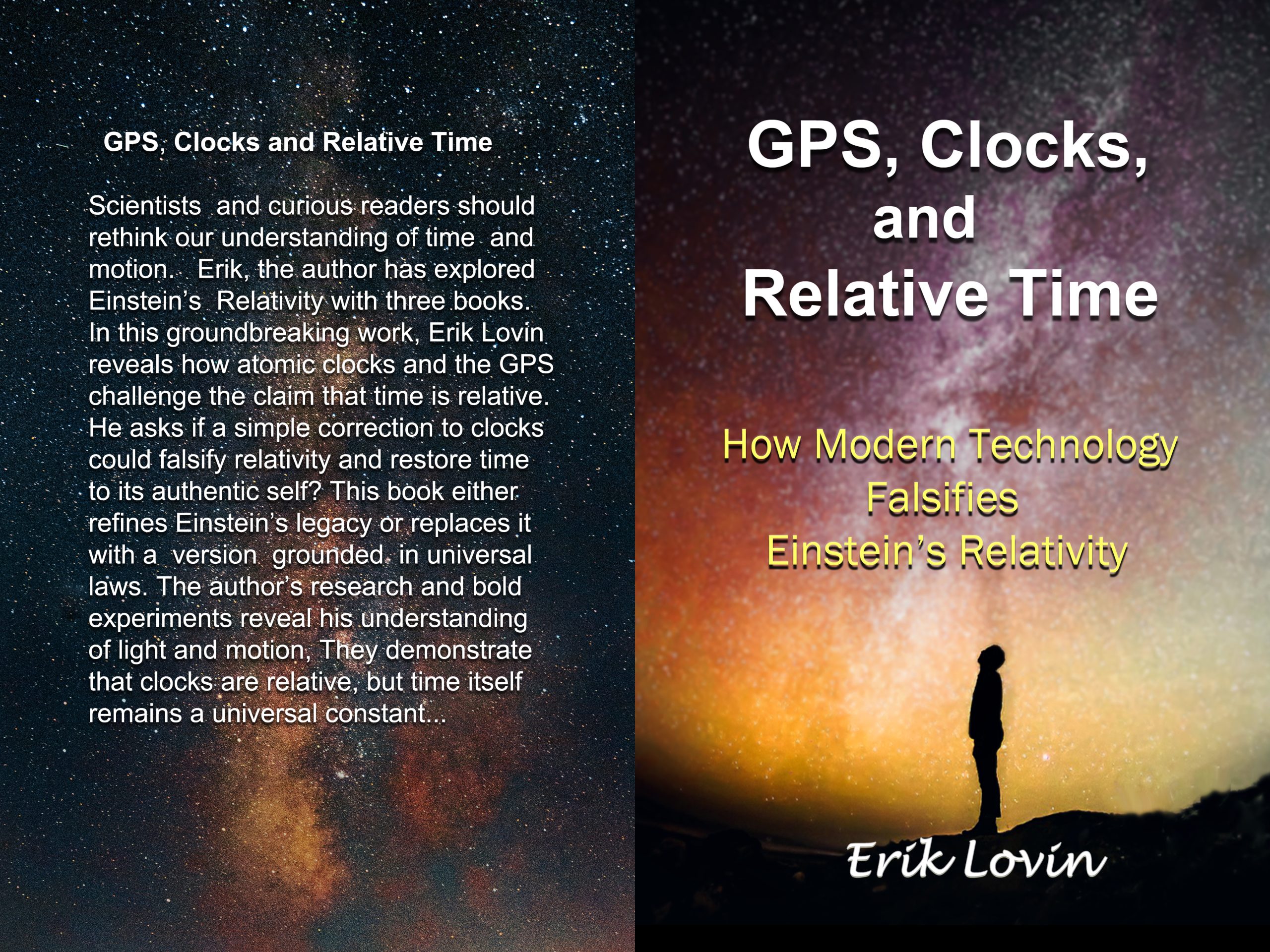
In this timely message, we journey through time and space, finding authentic time grounded in physical reality rather than Einstein’s relativity. Young Albert imagined riding on a beam of light, and since then, scientists haven’t thought about time the same way. Yet, more than a century later, a truth emerges from the very technology that uses his equations. Orbiting above Earth, GPS satellites reveal that only clocks are affected. The ticking rate of clocks slows or speeds up by the force of gravity, but time continues to flow at the same universal rate.
You will find that the book is designed to be easy for a layperson to understand, but it also includes the math and equations in the Appendix for serious scientists. Every apparent “relativistic effect” is traced to physical influences on clocks. No need for time dilation since physical reasons explain Mercury’s orbit, muon decay, gravitational redshift, and GPS.
Our goal is to show that a Universal Rate Correction restores any clock to absolute time. We will realize clocks are relative, and time returns to its authentic self. On our journey, we learn the properties of light and why it behaves as if it has mass and energy. We see it, we feel its heat, yet science claims photons are massless.
The book’s exceptional quality is that its diagrams, definitions of time, and mathematical equations show that Einstein’s relativity is backward. Time isn’t relative to an observer’s frame of reference. Time is absolute, and it comes from the motion of the universe, moving at the speed of light.
If you are curious about understanding the universe, it’s a definite read. You won’t regret the opportunity to learn about gravity, time, and the universe, which most people misunderstand.
Keeping track of our time has never been easier. A watch or clock costs less than ten dollars, although many use their phone to keep track of time. It’s challenging to describe time because we label events and activities in terms of time. Time waits for no one. Wait a minute, take the 12:00 pm bus, and meet me after lunchtime. I don’t want to waste my time; make me a three-minute egg.
A curious fact about time is that we don’t understand time itself. People believe that, given enough time, anything can happen, and without time, nothing can. People think that the Sun moves across the sky. Some think traveling at nearly the speed of light will make them younger, and that normal time makes them older. This kind of thinking is widespread.
This article explores a simple but radical idea: time is not a thing that flows or acts on us. Time is a measurement of motion, interpreted by our minds.We think time started with the universe, and if time didn’t exist, the universe couldn’t exist. What if time were to stop?…
What on Earth is Time?
A dictionary definition is that time is the measured or measurable period during which an action, process, or movement exists or continues to exist. How do we measure time events? For example, we use clocks to measure how long to boil an egg, but what do we really know about time itself?
Well, when I wake up, I want to know the time. Why? Because I like to know how long I slept and if I should get out of bed immediately. Why? If it’s the weekend, I don’t have to go to work or school. I can relax and take my time getting out of bed. It’s wonderful just to enjoy a moment of silence.
However, if I wake up late, miss my bus, and rush to work or school, it’s stressful. What’s the difference in time between a relaxing and a stressful time? Does time affect emotions? What’s our relationship with time? The beating heart has a rhythm that shifts with what we are experiencing…
The Concept of Time
We see the clock’s numbers moving, so we say time moves, but it’s the clock that moves. We see the Sun move across the sky. However, it’s the Earth that’s moving. Time is a measure of Earth’s motion, and the concept of time is simple…
Historically, clocks were designed to tick at the same speed as the Earth rotates, namely 86,400 ticks per day, which were divided into hours, minutes, and seconds. We use time to describe the events and duration of activities we experience. However, Time has nothing to do with the forces that cause events or the energy that beats your heart. Time is our experience of motion.
Time is What a Clock Shows
A time interval is a measurement of a motion interval. A clock counts each tick as a second of time, and we label the description of the force moving the Earth as time. We use clocks to count how long to cook food, how long to sleep, how fast we travel, and how far we drive.
We take shortcuts to describe events by using time. If we are talking about an event, we label it with time. For example, the 100 metre race, the day President Kennedy was shot, and don’t forget the 911 event. When we use a label, it skips the event’s description, and a calendar labels Historical events.
In ancient times, the motion of the Sun across the sky gave people the time of day and the month of the year. You see, time is a description of events. But time doesn’t exist as a standalone thing; time exists with the motion of the universe. A clock counts seconds and displays numbers, and we have been taught how to convert those numbers into time. So, to know the time, we need to use our minds, which has increased our relationship with time.
The Concept of Time
Time feels like a powerful force, but what is a clock actually measuring? Time consists of two parts. The illusion of time comes from our awareness of being alive, breathing, thinking, and feeling sensations. The physical motion of time is the movement of flowers in the wind, birds flying, and waves on the water. The motion we witness is the physical experience of time, and our awareness of time passing is the abstract part.
The invention of clocks brings together the physical motion and our awareness of motion into the concept of time. We use clocks to measure everything in terms of time, so we cannot live without time.
However, Time doesn’t control our lives; our minds do. Clocks do not make things happen; they only count seconds. When we use a measurement as a force, we give time an authority it does not possess. Understanding this may be the first step toward understanding our relationship with time. Imagine if time is a measurement of motion, what is actually moving?…