Space is the medium for everything visible in the universe. When we say we live in the 3rd dimension, we don’t think of dimensions as the invisible medium around us. Perhaps even the universe is a dimension within a greater realm. At the beginning of the universe, before galaxies existed, the universe’s raw matter of hydrogen and helium formed into giant gas balls. The immense force of gravity triggered nuclear fusions, forming giant stars.
The theory is that these early stars created elements up to iron through stellar nucleosynthesis, a process in which immense core pressures and temperatures fused the lighter elements hydrogen and helium into progressively heavier ones, such as carbon, oxygen, and silicon, and finally iron, which marks the end of the process. However, we don’t know precisely how newly formed stars made heavier elements, but they did. Eventually, the generation of stars culminated in supernova explosions that produced the remaining elements and initiated the formation of planets and galaxies.
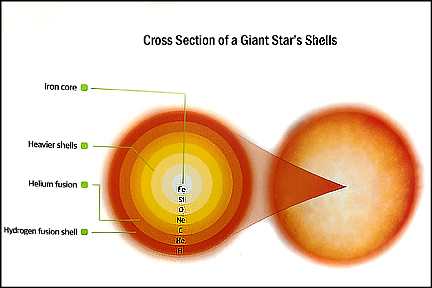
A giant star has shells of various atoms, and fusion stops when it reaches iron.
The nuclear fusion process continues making heavier elements until the star’s core is mostly iron. The fusion of iron isn’t possible, so the star has run out of fuel, and it causes a supernova reaction. Why? The outward nuclear explosions from the star’s core were in balance, with the inward force of gravity preventing the outer layers from travelling into the core.
When a star has depleted its nuclear fuel, gravity pulls the outer layers towards the iron core. The matter hits the iron core at speeds of 23% the speed of light. This triggers a supernova explosion that can cause a black hole.
What is a Black Hole and How is it Made?
Giant stars were, perhaps, billions of times the size of our Sun. During a supernova, most of the star’s outer layers are blown into space, leaving a black hole. A supernova is the most powerful force in the universe. When a star explodes, it sends most of the star’s outer material into space, and the heavier atoms in the periodic table are created and ejected into space.
But the exploding star has an equal and opposite force that implodes onto the iron core. Moreover, the iron core also collapses inward by gravity during the supernova. The result is that when these two massive forces act together, they create a black hole.

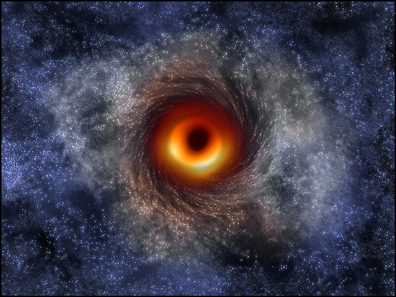
This is the first real photo of a black hole, released by NASA in April 2018.
During the iron core’s collapse and the immense implosion, a phase transition occurs. The iron core transitions to a higher frequency dimension. Such a dimension isn’t inside the Black hole or 3rd dimension because frequencies separate dimensions. Each time matter changes form, it requires energy to transition between phases. For instance, when ice transitions into water, water into a gas, or gas into a plasma, there is an energy barrier between the water phases. You can think of these energy barriers between phases as frequencies that separate dimensions.
A Black Hole is a portal into another dimension. Examine the diagram showing the mechanics of a phase transition.

A Black hole creates a tunnel into another energy level of the universe.
The event horizon is the point of no return. A phase transition changes matter into a higher-energy state. The membrane between levels keeps energies separate, but gravity is a long-range force that can “reach” our dimension. That explains why galaxies orbit the sources of gravity around Black holes.
The Universe has Dimensions of Energy
If you are skeptical about other energy levels or dimensions, consider where the Big Bang came from. If dimensions are “energy levels,” it’s easier to understand. The universe is 13.8 billion years old and began with the Big Bang; therefore, it’s proof that other dimensions exist.
A universe can’t start from nothing.
If you think the universe is eternal or materialized out of space in a quantum fluctuation… Then, where did the energy come from to create the universe? You can’t escape the fact that there is a Source dimension that supplies energy to the universe.
That source must be in a different dimension or realm with unlimited energy and intelligence. Black holes are a mini example of energy moving matter into another dimension. The Big Bang event released enough energy to create the entire universe, while black holes channel energy into higher frequencies.
The scientific proof is in the amount of matter in the 3rd dimension. Our dimension accounts for only 5% of the universe’s total mass and energy. Where is the other 95%? Black holes emit a strong gravitational field due to higher frequencies. Since our dimension accounts for only 5% of the total mass, the remaining 95% isn’t merely inside black holes. If the gravity were in black holes, the total mass in our dimension would be 100%.
The answer is that Black holes are portals into another dimension. Matter moves into Black holes and emerges from White holes into a higher-frequency dimension.
What dimension has the most energy?
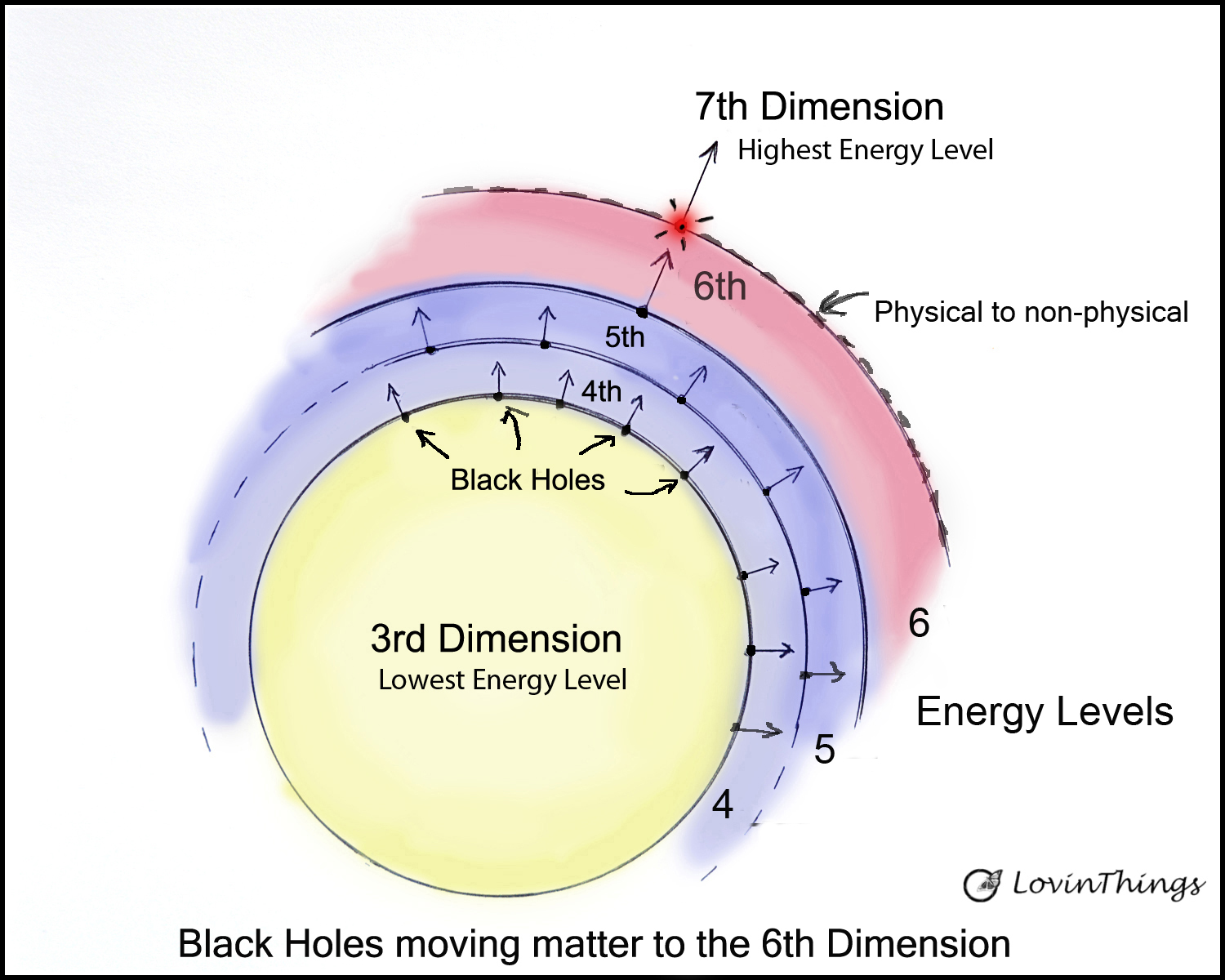
Black Holes and Dark Matter
Matter is attracted into Black holes, but it isn’t inside them. It means that the gravitational force from Black holes comes from somewhere else, namely, another dimension. Thus, Black holes are portals to another energy level, and the intense gravity emanating from them reaches us. Now, for the moment you’ve been wondering about… the matter that moves into Black holes is what we are calling dark matter… That’s why we can’t find any dark matter in our dimension.
Dark matter is ordinary matter that has gone into a higher energy level, and the long-range force of gravity reaches our dimension. As more and more matter leaves our dimension, we experience a stronger attraction towards that dimension.
The Purpose of Black Holes
The Universe needs Black holes because they create the structure of galaxies. Most of the matter ejected from a star’s supernova forms new stars and planets, which appear around Black holes. Additionally, Black holes increase the universe’s entropy by converting ordinary matter into higher-energy matter that changes to higher frequencies. The movement of energy is mistakenly referred to as time; however, it’s the evolution of energy returning to its source. The movement of matter into higher frequencies is the mechanism of change. Time is just the measurement of the motion we experience.
The Event Horizon
The size of the event horizon determines the size and strength of Black holes. The event horizon is a circular region around the Black hole that is said to be linked to the speed of light so that any object, including light, can not escape the region beyond the event horizon. However, the real reason light can’t escape is that the portal is a one-way tunnel. Matter, including light, moves into the portal and into the next dimension. Nothing can come back out except the force of gravity, which doesn’t have mass.

An Artist’s view of the event horizon is the black ball, representing the region of no return.
Time Dilation
Time dilation occurs in clocks near a strong gravitational field. The science-fiction definition means that if we could see a spaceship falling towards a black hole, it would happen in slow motion. The ultimate truth is that time doesn’t affect motion. Only the clock’s mechanism is affected. A spaceship moves at relativistic speeds, and we wouldn’t see anything because black holes are millions of light-years away from Earth. Learn the definition of time here.
Spaghettification
Spaghettification is a science-fiction concept invented by Stephen Hawking. His theory suggests that the force of gravity is stronger the closer you are to a singularity at the center of a black hole. He claims that if an astronaut falls into a black hole, he will be stretched and pulled apart because the force of gravity acting on his feet is much stronger than that acting on his head. However, Black holes are millions of light-years away, so we would never reach them.

Your body falling into a black hole gets stretched like spaghetti…
Hawking Radiation
In 1974, Stephen Hawking announced in a seminar that a Black hole could lose energy by blackbody radiation, get smaller, and eventually vanish. This has not been the case since more matter is constantly moving into Black holes. Hawking radiation doesn’t work because a Black hole isn’t like a regular blackbody that radiates energy. Scientists are still confused by the math and energy of Black holes because they don’t believe that other dimensions exist.
Black and White Holes
A Black hole appears completely black because even light disappears into the event horizon. A white hole is the other end of the portal into a higher frequency dimension. If we were in that dimension, we would see white lights in the night sky. When all the matter from the 3rd dimension is in the 4th dimension, the white holes would fade and vanish, but new Black holes would start… The evolution of matter continues into higher frequencies.
The Einstein-Rosen bridge

The Einstein-Rosen bridge shows how a Black hole could connect to an exit White hole.
Inside Black Holes
What could we see inside a Black hole? Black holes are tunnels to a phase transition. The super-strong gravitational field means nothing is visible. The tunnel is a phase-transition portal, and the only thing inside is gravity. For example, when ice turns into water, we have ice or water, not molecules that are half ice and half water. The transition phase depends on the energy levels separating the phases.
The End of Time
Time is the measurement of motion that began with the Big Bang. The end of time for our physical universe will occur when the motion of energy returns to the universe’s Source dimension. That event will be the reverse of the Big Bang. When the matter from all dimensions reaches the 6th dimension, the frequencies transition from the physical into the non-physical, from mass into massless, and from visible into non-visible.
Finally, a Big Bang returns all energy to the source that created the universe, and time ends for this universe. Our universe is approaching old age, and we may have less than one billion years left. Where will we go when the universe comes to an end?
Eventually, all matter will return to the source from which it came. The obvious question is, what happens to us when that happens? That’s a good question, and we will answer it in an article about consciousness and the purpose of life. This was the latest and most up-to-date information about Black holes. I hope it answers any questions that you have. I want to encourage you and confirm your belief that science will reveal the Physical Truth, but the Ultimate Truth comes from merging science and consciousness. Erik at Science in Your Life, https://lovinthings.com